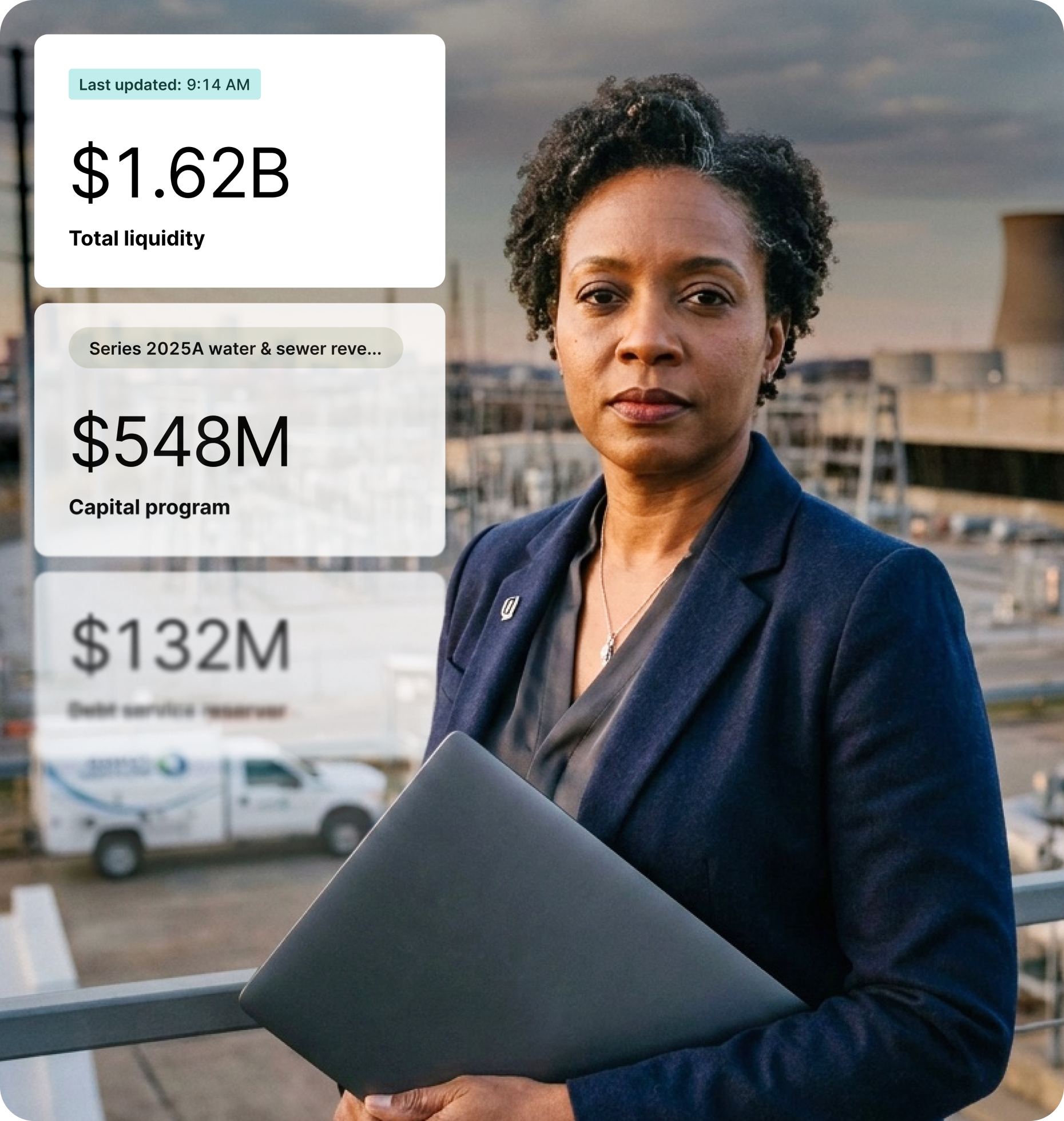
One platform for every dollar your utility manages — operating cash, multi-year capital programs, restricted loan and bond proceeds, reserves, and investments.
If this is how your finance office runs today, we built this for you.
Problem #1
The cash position is scattered across the capital program, operating, fee funds, and reserves.
Only about 1 in 5 government and nonprofit organizations has real-time visibility into its liquidity position; more than 40% compile it by hand. At a utility, that cash is spread across operating, bond proceeds, SRF and WIFIA loan funds, renewal-and-replacement and rate-stabilization reserves — across many banking relationships.
Between the revenue fund, the bond construction accounts, the SRF draws, and operating, our actual position lives in a dozen bank portals and a spreadsheet I rebuild every morning.
Finance DirectorRegional Water Authority, West Coast
Problem #2
The debt program lives in spreadsheets — and the rate covenant in someone's head.
Utility capital programs are financed through a stack most tools have never seen — water, sewer, and electric revenue bonds, State Revolving Fund and WIFIA loans, commercial paper, variable-rate debt — each with rate covenants, coverage tests, and continuing disclosure. Most finance offices rebuild the schedule, the covenant calculation, and the disclosure calendar from primary documents every cycle.
We fund the treatment plant with revenue bonds, a WIFIA loan, state SRF loans, and commercial paper, and the calculation that proves we’re meeting our rate covenant and additional-bonds test is a spreadsheet only one analyst really understands.
Director of FinanceMunicipal Utility, Southeast
Problem #3
Loan compliance, GASB, and audit prep consume the team’s strategic time.
State Revolving Fund and WIFIA loans carry their own eligibility, drawdown, and reporting rules on top of GASB. Utilities are landlords too — cell-antenna leases on water towers, land and easement agreements — and every department signs equipment leases and operational software subscriptions accounting never sees, so population completeness becomes the hardest part of close. GASB 87 and 96 are continuous obligations, not year-end projects.
Every department signs SCADA software and equipment leases without telling accounting, and every SRF dollar has its own drawdown and reporting rules. Pulling it all together before the auditors arrive is the hardest part of close.
ControllerSewer District, Mountain West
What Monetary does
Protect, deploy, and optimize every dollar your utility is responsible for.
Protect every dollar
See every dollar. Catch every risk.
Visibility is how you protect ratepayer money and the capital program it funds. Operating cash, restricted bond proceeds, SRF and WIFIA loan funds, debt service and renewal-and-replacement reserves, the rate stabilization fund, the investment portfolio, and the controls around them — in one place, in real time.
Put every dollar to work, on a forecast your board trusts.
A 13-week rolling forecast with fund- and project-level detail. Tiered liquidity built into how the platform thinks. Bond construction draws, rate revenue, and operating cash on one screen — so you fund the treatment plant, the pipeline replacement, or the grid upgrade on schedule without stranding cash. Stop compiling. Start deciding.
Save on every dollar you borrow. Earn on every dollar you hold.
Refunding opportunities across the utility’s debt programs, surfaced automatically. Yield gaps flagged against your investment policy — meaningful on reserves, rate-stabilization balances, and construction funds that sit invested for years during a multi-year build-out. Peer benchmarks aggregated across water, wastewater, and public power utilities like yours — so you walk into the next board or rate-setting meeting knowing where you stand.
The AI analyst that knows your debt programs, cash position, and investment policy.
Marty is grounded in your finance office’s data — not the internet. Every answer links back to the underlying source. Every action requires your explicit review and approval.
Liquidity by fund and program
Rate covenant against threshold
SRF / WIFIA loan drawdown
By the numbers
The financial case for an active, purpose-built treasury platform.
Organizations using Monetary TMS typically generate $500K – $1M+ in annual value across debt savings, cash yield, staff productivity, and compliance risk reduction — achieving full payback in under 18 months.
10–15 bps
reduction in borrowing costs. Worth ~$50K-$75K/year for every ~$50M refinanced.
75 - 100 bps
in unlocked yield from deploying idle cash into higher rates.
40 - 60%
reduction in manual treasury task hours. Equivalent to 1.5-2 FTE redirected to strategic work.
60–70%
reduction in non-compliance penalties.
Based upon the University of Chicago Center for Municipal Finance research, Minnesota Benchmarking Study by IBM, U.S. BLS reports and other publicly available industry benchmarks. Outcomes vary by entity.
Why Monetary exists
Built for the way utility systems actually finance capital.
Enterprise-fund accounting. Tax-exempt bond proceeds. SRF and WIFIA loan compliance. Rate covenants and additional-bonds tests. GASB 87 and 96, as lessee and lessor. None of this exists in corporate finance — and no corporate platform can be configured into it.
Every dollar tagged to a fund. Every fund reconcilable to the bank.
Utility finance runs as an enterprise fund — operating, capital, debt service, reserve, and rate-stabilization funds, plus rate and connection-fee revenue. Bond, SRF, and WIFIA proceeds spend down by project, each with its own drawdown and reimbursement rules. Monetary was built around fund-level detail from day one.
GASB 87 and 96, built in — as lessee and lessor.
A utility is a landlord — antenna leases on water towers, land and easement agreements — and a tenant on vehicles, equipment, and software. Monetary handles GASB 87 lessee and lessor accounting and GASB 96 subscriptions, surfacing embedded leases and SCADA, metering, and billing subscriptions before they become audit findings.
Your investment policy and revenue-bond covenants, monitored live.
Your board-approved investment policy is enforced continuously, monitored in real time. Rate covenants and additional-bonds tests track against the system of record — so any drift toward a limit surfaces the same day, with audit-ready evidence on demand.
Revenue funds, loan draws, custodians, and bond trustees — unified in one view.
Operating cash at the bank, rate revenue at another, reserves at a custodian, bond proceeds at a trustee, SRF and WIFIA reimbursements on the loan schedule. Most corporate tools don’t connect to municipal trustees or LGIPs at all. Monetary unifies them into one real-time view.
FAQs
What other utility finance leaders ask before they buy.
Your ERP and billing / CIS are your utility’s accounting and customer-revenue command center. Monetary sits next to them as your debt, cash, and investment command center — the work those systems were never designed for: covenant and additional-bonds-test tracking, bond proceeds and loan-fund spend-down, SRF and WIFIA compliance, continuing disclosure, and real-time liquidity across funds and projects. We integrate with the major ERPs and feed them the journal entries they need.
Monetary supports portfolios of every size — from a small rural water district to a regional water and wastewater authority financing a multi-billion-dollar capital program. The Massachusetts Water Resources Authority — which delivers water and wastewater services to 3.1 million people across metropolitan Boston — runs on Monetary. The platform scales from one fund to dozens without changing how your team works.
Fully operational in 120 days. Zero IT involvement required — Monetary is cloud-native, browser-based, SOC 2 compliant, and connects to your ERP, banks, custodians, and trustees through pre-built integrations. Partner-led implementations available through CPA firms, financial advisors, and treasury advisors.
Organizations using Monetary TMS typically generate $500K–$1M+ in annual value across debt savings, cash yield, staff productivity, and compliance risk reduction — achieving full payback in under 18 months.
See Monetary running on a utility like yours.
See what Monetary looks like for your finance office — with your debt program, your capital-program cash position, your SRF and WIFIA loan funds, and your investment policy at the center of the demo.