

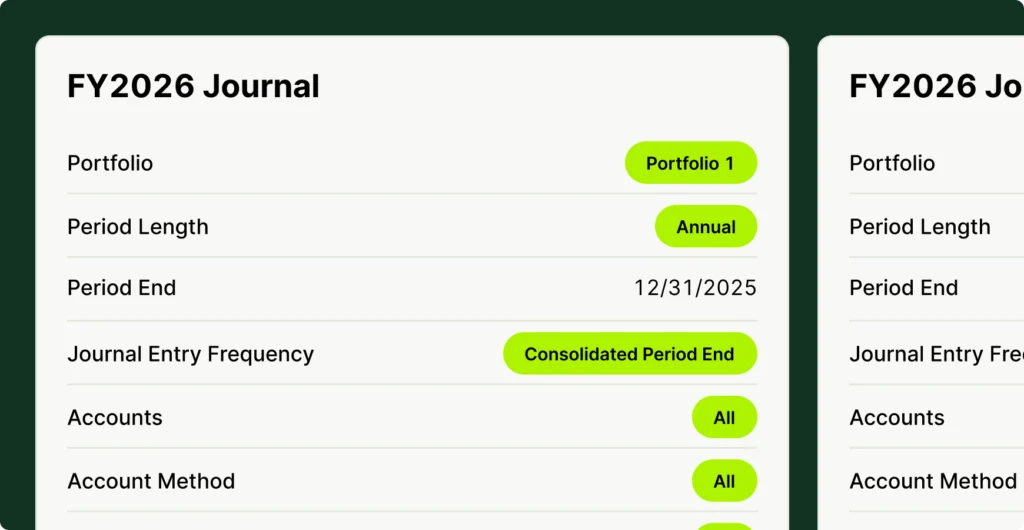
Journal entries
Generate accurate journal entries — payments, accrued interest, amortizations, and year-end conversion — for any period, on both modified and full accrual bases.











Treasury maintains the debt schedules. Then someone in accounting re-enters payments, accrued interest, and amortization into the general ledger every period — by hand, from a spreadsheet, hoping nothing changed since the last version. One refunding or modification, and the two copies quietly fall out of sync.

Full-accrual conversion, premium and discount amortization, the long-term obligation note — all rebuilt under deadline, every close. The work to assemble the numbers is bigger than the numbers themselves, and the auditors are already waiting.

Original issue premium and discount amortization — effective interest or straight-line — maintained by hand, one tab per series, one formula away from a restatement.
The Excel spreadsheet housing all of our debt was well-constructed initially, but over time, with every update, it became unstable and clunky.
 Ghazala BibiController, UNC Greensboro

Generate accurate journal entries — payments, accrued interest, amortizations, and year-end conversion — for any period, on both modified and full accrual bases.

Map a debt-specific chart of accounts and your GL codes to your debt portfolio, with customizable formats that match how you already report — so entries reconcile faster and tie cleanly to your ERP.

Calculate and generate original issue premium and discount amortization schedules using the methodology you report under — effective interest rate or straight-line.

Produce the long-term obligation activity for your year-end financial disclosures, and allocate debt service across any number of dimensions — fund, department, project — so every number lands where it belongs.

Your journal entries, accrued interest, and amortization come straight from the portfolio your team already maintains — not a separate spreadsheet that has to be kept in step by hand.

Modified and full accrual bases, year-end conversion, ACFR exhibits, and the long-term obligation note — the way government and nonprofit teams actually account for debt, not a corporate sub-ledger bent to fit.

Every entry is documented and traceable to its source. Give your auditors their own access and let them follow the trail themselves — you stop being the bottleneck.

Ask Marty for the accrued interest posting through year-end, or the premium amortization on a series, and every answer links back to the underlying entry. Marty surfaces and answers — every journal entry you post requires your review and explicit approval.

“Previously, we assumed the bank invoices were always right. With Monetary, we caught the error and corrected it. That alone saved us a substantial amount of money.”

Analyze new-issue structuring options directly within Monetary.

Track project spending and private-use data on bond-funded projects.

Track variable rate resets and commercial paper draws, rolls, and payoffs in one place.

Filter and analyze your outstanding par across type, purpose, and fund.
Book a demo and we’ll show Debt Accounting on your debt — your schedules, your chart of accounts, your year-end conversion — so you can see exactly how the entries come together.


