

How modern teams plan with confidence
A practical guide to connected reporting
Government Treasury Teams Deserve Better: The Case for Purpose-Built Technology in Public Finance
There is a workforce that sits at the financial foundation of every American community: the government finance and treasury professional. They are often small teams, sometimes a department of one, managing the cash, debt, investments, and compliance obligations of cities, counties, school districts, and public universities. Their work funds the roads we drive on, the schools our children attend, and the emergency services we depend on. And yet, as an industry, we have largely left them behind when it comes to technology.
These teams carry a disproportionate burden. They operate under intense public accountability, strict regulatory requirements, and the constant pressure to do more with less, all while managing workforces that are aging and, in many cases, shrinking.
The institutional knowledge walking out the door when a veteran treasurer retires is not easily replaced, and the manual, spreadsheet-driven processes they leave behind are not a sustainable foundation for the next generation of public finance professionals.
“We do our best with the information we’re given, but we don’t always have the full story in a timely way.” — County Treasurer, Midwestern County
That quote, shared with us by a client, captures the central frustration of government treasury operations today. It’s not a complaint about effort or capability. It’s a structural problem, a technology gap that has persisted far too long.
The Private Sector Gets Tools. Government Gets Spreadsheets.
The treasury technology market is robust, if you work in corporate finance. There are sophisticated, well-resourced platforms built for Fortune 500 treasury departments, commercial banks, and asset managers. These tools handle multi-entity cash consolidation, real-time bank connectivity, forecasting engines, and investment analytics with elegance and depth.
Government treasury teams, by contrast, have been largely served by tools built for someone else and adapted, imperfectly, for their needs. The problem is not just a matter of feature gaps, but a matter of fundamental domain fit. Government treasury operations have requirements that are structurally different from private sector treasury, and generic tools simply cannot address them well.
Consider what is unique to the governmental context: tax-exempt debt and the regulatory compliance that surrounds it; GASB 87 and GASB 96 accounting standards for leases and subscription-based IT arrangements; the rigid seasonality of cash flows driven by property tax collection cycles, debt service payment schedules, and legislative appropriations; bond proceed spend-down requirements and private business use tracking; and the multi-fund, multi-entity reporting structures that characterize virtually every government balance sheet.
These are not edge cases. They are the daily reality of public finance, and they are largely invisible to platforms designed for the private sector.
The Cost of Siloed Data and Partial Visibility
When technology fails to harmonize the myriad systems, spreadsheets, and departmental data sources that government finance teams depend on, the result is not merely inefficiency. It’s a fundamental inability to manage liquidity with confidence.
A recent study conducted by the University of Chicago across 168 local governments, including state agencies, cities, counties, school districts, and higher education institutions, found that treasury teams spend approximately 50% of their time on data assembly: pulling bank balances from multiple portals, reconciling spreadsheets, chasing ERP exports, and manually aggregating information that should be available instantly.
Another 30% goes to reporting and disclosure. That leaves just 20% of capacity for the strategic work that actually matters such as forecasting, scenario analysis, investment optimization, and capital planning decisions.
This is not a reflection of the people doing the work. It’s a reflection of the tools they have been given. When your cash position requires logging into five different bank portals, when your debt service schedule lives in a spreadsheet disconnected from your cash forecast, and when your investment maturities are tracked separately from your liquidity planning, you are not managing treasury, you are assembling data. And the decisions that suffer as a result are not abstract. They are decisions about whether to draw on a line of credit, whether to invest idle cash, whether bond proceeds are being spent on schedule, and whether the community has the liquidity it needs to fund the services its residents depend on.
Government treasury teams spend 50% of their time assembling data, leaving only 20% for the strategic work that actually protects community liquidity.
Unfortunately, many governments are forced to make consequential financial decisions based on partial information, not because they lack diligence, but because the data they need is not accessible in a timely, integrated way. That is frustrating. And in 2026, with the technology that exists, it is also unacceptable.
What Good Looks Like: A Case for Tiered, Disciplined Forecasting
The GFOA has long recommended that governments maintain at least two months of operating expenditures in unrestricted fund balance, and conduct ongoing cash forecasting on a rolling 12-month basis. These are sound guidelines, but they represent a floor, not a ceiling. And critically, they leave open the question of how, operationally, governments should build and maintain the forecasting discipline that makes those guidelines meaningful in practice.
Based on experience working with government finance teams across the country, I would suggest that best-in-class government treasury operations employ a three-tiered forecasting framework:
1. Strategic horizon (12-month rolling): Major inflows and outflows analyzed monthly. Investment maturities modeled against forecasted obligations.
2. Tactical horizon (1–3 months, weekly detail): Specific large payment flows such as debt service, payroll, capital expenditures are identified and matched against maturing investments or available proceeds. Cash and short-term liquidity investments available for redemption should cover up to 2x the average monthly outflow.
3. Operational horizon (daily cash position, 3–5 day outlook): Prior-day bank statements reviewed daily. Near-term payment flows forecasted using invoice-level detail, payroll schedules, debt service settlement dates, and other material flows.
Each tier serves a different decision and together they create the layered confidence that transforms a treasury operation from reactive to proactive.
The Forecast-to-Actual Feedback Loop: The Most Underappreciated Best Practice
Of all the operational disciplines in government treasury management, the one I would most want to see elevated in formal best practice guidance is the forecast-to-actual variance process. No forecast is perfectly accurate, the nature of governmental cash flows, driven by legislative cycles, grant timing, tax collection patterns, and factors outside treasury’s direct control, makes perfect prediction impossible. It’s simply reality.
What matters is the discipline of regularly comparing forecast projections against bank-reported actuals, identifying where and why variances occurred, and using those insights to tighten future forecasts. This should be done at minimum monthly and more frequently for governments managing complex or high-volume cash flows.
The value of this discipline extends well beyond forecast accuracy. A structured variance review enables finance teams to roll forward late receipts that did not materialize in the forecasted period; identify unexpected disbursement behavior, which also functions as an important internal fraud control; monitor bond proceeds drawdowns and confirm that expenditures are executing on schedule; and capture new investment maturities that may affect near-term liquidity. It also enables finance directors and CFOs to respond with confidence when city managers or finance committees ask about cash flow budget performance, a question that too often catches treasury teams flat-footed because the analysis was not being done in real time.
The bank statement is the source of truth. The forecast is a hypothesis. The variance analysis is how you learn. Governments that build this discipline into their operating rhythm, rather than waiting until month-end or quarter-end to see where cash landed, are fundamentally better positioned to manage liquidity and protect the communities they serve.
Modern Technology Changes What is Possible
The good news is that the technology to support all of this now exists and for the first time, it is being built specifically for government.
Modern bank connectivity solutions, ERP integrations, and purpose-built treasury platforms now make it possible for government finance teams to have a single, integrated view of cash positions across multiple banks and custodians; a living cash flow forecast that draws automatically from debt service schedules, investment maturities, payroll systems, and AP data; real-time forecast-to-actual variance analysis without manual data assembly; and the compliance and disclosure outputs that government finance requires, from GASB compliance across debt, investment, lease and subscription management, to ACFR footnotes and investment policy reporting.
The vision is not incremental improvement on a spreadsheet model. It’s a fundamentally different operating posture, one where the data speaks for itself, where decisions are informed by a confident and complete picture, and where treasury professionals spend their time on the analysis and judgment that only they can provide.
This matters not just for the efficiency of finance departments. It matters for the communities those departments serve.
When a government treasurer has a confident, real-time view of liquidity, they can make better decisions about when to invest idle cash, when to draw on a credit facility, when bond proceeds are available to fund a capital project, and whether the government has the financial resilience to absorb an unexpected shock.
When that visibility is absent, when the picture is assembled from stale spreadsheets, partial bank data, and disconnected systems, those decisions are made with less confidence than they deserve.
The Obligation to Do Better
Government finance professionals have accepted a level of technological limitation for too long, not because they lack ambition, but because the market did not offer them viable alternatives. That is changing. And as it changes, I believe those of us who work alongside these teams have an obligation to advocate loudly for the standards, tools, and practices that will allow them to do their jobs with the confidence and capability that their communities deserve.
The GFOA guidelines on cash forecasting and fund balance reserves are a strong foundation. But guidelines are only as powerful as the operational infrastructure that supports them. Technology that unifies data, automates the routine, and surfaces insight is not a luxury for government treasury operations, it is a necessity. And the communities we live and work in are better served when the finance professionals protecting their liquidity have the tools to do so.
The Impact of Treasury Discipline: What the University of Chicago Study Reveals
Learn MoreRelated Treasury Management Reading
- Why Public Finance Managers Need a Modern Treasury Management System
- Breaking Down the Math Behind Municipal Bonds
- Debt Service Calculator for Tax-Exempt Bonds
Disclaimer: Monetary does not provide professional services or advice. Monetary has prepared these materials for general informational and educational purposes, which means we have not tailored the information to your specific circumstances. Please consult your professional advisors before taking action based on any information in these materials. Any use of this information is solely at your own risk.
What Are Local Government Investment Pools?
Most local government investment pools (LGIP) guidance treats the pool as a product decision. For a public finance team, it’s closer to an operations decision.
The vehicle itself is simple.
The work that determines whether it actually does its job is choosing it for the right purpose, accounting for it correctly under GASB, and connecting it to the rest of your cash and investment picture.
A LGIP is a pooled investment vehicle, operated by a state or a joint group of public entities, that allows governments to invest cash collectively. Similar in concept to a money market fund, an LGIP pools participant deposits and invests them in a portfolio of short-term, high-quality securities designed to preserve capital, provide liquidity, and generate income.
That definition is the easy part. The rest of this guide covers the harder part: how pools work in practice, where stable-NAV and variable-NAV structures fit, what GASB 79, 31, 40, and 72 require, how to evaluate a pool against your investment policy and cash forecast, and how to manage the position once the money is in. Yield comes up in each of those sections. It is the last question, not the first.
What is an LGIP?
An LGIP gives eligible public entities access to a professionally managed portfolio without requiring each organization to build that portfolio on its own.
The Government Finance Officers Association (GFOA) describes LGIPs as pooled investment funds typically overseen by a state treasurer or authorized governing board for the benefit of public entities within the jurisdiction. Governments participate by purchasing shares or units in the pool, which invests participant funds in a diversified portfolio of short-term securities.
While the structure resembles a money market fund, LGIPs are built for public entities and typically rely on a governmental exemption from SEC mutual fund registration. Oversight, eligible investments, and participant rules come from state law and the pool’s governing documents rather than SEC Rule 2a-7.
For many public entities, managing a diversified short-term investment portfolio internally may not be practical. By participating in an LGIP, governments gain access to capabilities that might otherwise require significant internal resources, including:
- Professional portfolio management
- Diversification across multiple securities
- Economies of scale
- Regular reporting and transparency
- Liquidity designed for public-sector cash needs
LGIPs Are Designed Around Public Funds Priorities
Unlike investment strategies focused primarily on maximizing returns, LGIPs are generally structured around the priorities that govern public funds management. While specific objectives vary by state and pool, most focus on:
- Safety of principal
- Liquidity for operating and cash-flow needs
- Yield, consistent with safety and liquidity objectives
- Compliance with applicable laws and investment policies
- Transparency and accountability for participants
For most public entities, preserving capital and maintaining liquidity take precedence over pursuing additional yield. As a result, LGIPs are typically evaluated as cash-management and liquidity tools rather than long-term investment vehicles.
How LGIP Accounts Work
An LGIP participant usually opens an account with the pool sponsor so authorized users can move money under the pool’s operating procedures. In day-to-day use, that process looks familiar to a treasury team.
- Deposits move by wire, ACH, or another approved transfer method.
- Redemptions are requested through the pool’s portal, phone process, or written instruction.
- Same-day access depends on the pool’s cutoff times, transaction rules, and liquidity procedures.
The pool then invests the combined cash in permitted instruments. Depending on state law and pool policy, eligible investments can include:
- U.S. Treasury obligations
- Federal agency securities
- Municipal obligations
- Certificates of deposit
- Commercial paper
- Repurchase agreements
- Other short-term instruments
The participant does not own a specific bill, note, or security, but instead owns a share or unit of the pool. Yield is earned by the portfolio and allocated back to participants according to the pool’s methodology.
GFOA notes that interest is normally allocated daily, proportionate to the participant’s investment. Some pools credit interest monthly, while others compound and pay earnings daily. The pool’s information statement or operating procedures should explain the calculation method, crediting schedule, fee treatment, and statement presentation.
Those statements become source documents for accounting, reconciliation, cash reporting, and financial statement support. For many public finance teams, that information should not be standalone statements reviewed only at month-end. The mechanics of moving money in and out of a pool are simple. The operating work those mechanics create, recording earnings, reconciling balances, tying activity back to the right fund, is where most of the time goes.
For example, Washington State’s Local Government Investment Pool allocates net earnings daily based on each participant’s pro rata share of total pool deposits, then credits those earnings to participant accounts at month-end. A government that increases its balance during the month earns a larger share of the pool’s income based on the amount and timing of those deposits. The same reporting framework also supports participant statements, reconciliation, and cash-position monitoring.
Stable NAV and Variable NAV
One of the most important factors when evaluating an LGIP is whether the pool operates with a stable net asset value (NAV) or a variable NAV.
NAV is the value of one share or unit in the pool. A stable-NAV pool seeks to maintain a constant share value, often $1.00 per share. These pools are typically designed for liquidity, capital preservation, and minimal price volatility, making them well-suited for operating cash, payroll reserves, debt service funds, and other balances that may be needed on short notice.
Many stable-NAV pools are designed to meet the criteria established by GASB Statement No. 79, which permits qualifying external investment pools and their participants to use amortized cost-based measurement for financial reporting instead of fair value measurement.
A variable-NAV pool allows the share value to move with the market value of the underlying portfolio. These pools may hold longer-term securities or take more interest-rate exposure in pursuit of higher yield. That can make sense for money with a longer time horizon, but it changes the risk profile: the amount you redeem may be higher or lower than the original investment amount.
| Pool Type | Typical Objective | Best Fit | Trade-Off |
| Stable NAV | Maintain a constant share value, commonly $1.00 | Operating liquidity and funds that need minimal price volatility | Yield may be lower than longer-duration options |
| Variable NAV | Allow share value to fluctuate with market prices | Longer-term reserves or strategic cash with more flexibility | Principal value can move up or down |
GFOA’s guidance makes this distinction central to due diligence. Stable-NAV pools are used for funds that prioritize liquidity and stability, while variable-NAV pools may be better suited for cash that can tolerate market fluctuations in exchange for the potential for higher returns.
Importantly, a stable NAV does not eliminate risk. Even when a pool seeks to maintain a constant share price, participants should still evaluate the pool’s portfolio composition, liquidity profile, governance structure, and investment policies.
This is where many organizations get into trouble. They compare yield without first matching the pool to the cash need. A government funding next week’s payroll has different liquidity needs than one investing reserves that may not be used for several years. Matching the pool’s structure to the expected use of funds is often more important than maximizing return.
Rated and Unrated Pools
Another important consideration is whether an LGIP carries a rating from an independent rating agency.
Ratings can provide an additional layer of due diligence by assessing factors such as portfolio credit quality, liquidity, diversification, maturity structure, management practices, and governance.
For stable-NAV pools, ratings generally focus on principal stability and the pool’s ability to maintain a constant share value. For variable-NAV pools, ratings may also consider sensitivity to changing market conditions and price volatility.
A strong rating can help treasury teams compare pools and may support compliance with investment policies that require or prefer externally rated investments. However, ratings are opinions based on established methodologies and ongoing surveillance. They are not guarantees of performance, liquidity, or principal preservation.
| Consideration | Rated Pool | Unrated Pool |
| Due diligence | Includes an independent rating opinion | Relies more heavily on your own review |
| Policy compliance | May help satisfy policies that reference ratings | Must be permitted under policy and state law |
| External validation | Ongoing surveillance by a rating agency | No third-party rating assessment |
| What to review | Rating report plus pool disclosures | Pool disclosures, governance, and portfolio details |
| Key question | Does the rating align with your risk needs? | Does the pool provide enough transparency and oversight? |
A rating can provide an additional point of comparison, particularly for organizations whose investment policies reference external ratings.
Likewise, an unrated pool is not necessarily riskier than a rated one. Many state-sponsored pools operate under conservative investment policies, statutory investment restrictions, and strong governance frameworks without obtaining a formal rating.
Whether a pool is rated or unrated, finance teams should evaluate several key questions:
- Does the pool’s investment strategy align with the purpose of your funds?
- Do the pool’s liquidity provisions support your expected cash-flow needs?
- What information is available about portfolio holdings, maturities, credit quality, and risk exposure?
- Does the pool provide sufficient reporting for accounting, reconciliation, disclosure, and audit support?
- Does participation comply with your governing statutes and investment policy?
The key question is not whether a pool is rated, but whether its structure, reporting, liquidity profile, and risk characteristics align with your organization’s requirements.
Why Public Entities Use LGIPs
LGIPs are popular because they solve a real operational problem: public entities need cash to work harder without sacrificing liquidity or policy control. The order matters, though: safety of principal first, then liquidity for operating needs, then yield consistent with both. Reading the same set of benefits as a flat feature checklist, with yield carrying the same weight as safety, is how teams end up in the wrong pool.
For smaller organizations, the benefit is scale. A township, school district, or public authority may not have the staff to manage a laddered portfolio, monitor credit quality, compare market rates, and process daily liquidity needs. A pool gives that organization access to a larger portfolio, full-time investment management, and participant reporting.
For larger organizations, the benefit is flexibility. An LGIP can serve as the daily liquidity layer. Bank deposits, direct securities, separately managed accounts, and other authorized investments can support different cash needs.
For most public entities, the main benefits fall into five categories.
- Liquidity: Many pools are designed for same-day or next-day access, subject to cutoff times and pool rules.
- Diversification: Participants gain exposure to a pool of securities rather than a single bank account or issuer.
- Professional Management: The pool sponsor or adviser manages credit, maturity, liquidity, and compliance within the pool’s policy.
- Economies of Scale: A larger pooled portfolio can access investment options, pricing, and operational resources individual participants may not reach alone.
- Competitive Yield: Pools often aim to provide a market-based short-term return while keeping safety and liquidity at the center.
Washington’s State Treasurer, for example, describes its LGIP objectives in priority order: safety of principal, adequate liquidity, and a competitive interest rate. That sequence is the public funds mandate in plain English, and it is the test for whether a given pool fits a given dollar.
The Risks Behind the Yield
LGIPs are generally designed to prioritize safety and liquidity, but they are not risk-free. Understanding how a pool manages risk is an important part of due diligence.
| Risk Type | What It Means | What to Review |
| Credit risk | An issuer or counterparty fails to meet its obligations | Credit quality, diversification, portfolio holdings |
| Interest-rate risk | Changes in rates affect investment values | Portfolio maturity profile, WAM, NAV structure |
| Liquidity risk | Access to cash may be affected during unusual conditions | Withdrawal procedures, liquidity requirements |
| Governance risk | Oversight, policies, or controls may be inadequate | Management structure, reporting, transparency |
Credit Risk
Credit risk is the possibility that an issuer or counterparty connected to the portfolio fails to meet its obligations. Diversification can reduce exposure to a single issuer, but it does not eliminate credit risk entirely.
Interest-Rate Risk
When interest rates change, the value of fixed-income securities can change as well. Stable-NAV pools generally manage this risk through short maturities, liquidity requirements, and portfolio constraints. Variable-NAV pools expose participants more directly to market-value fluctuations because share prices reflect changes in the underlying portfolio.
Liquidity Risk
Liquidity risk deserves special attention because access to cash is often the primary reason governments use an LGIP in the first place.
Many pools offer same-day liquidity under normal market conditions, but that does not always mean unlimited withdrawals at any time. Pool policies may include:
- Advance notice requirements for large withdrawals
- Daily transaction cutoffs
- Limits on certain transaction types
- Provisions designed to protect all participants during periods of market stress
That last category includes what are sometimes called liquidity gates: temporary restrictions on redemptions, redemption fees, or pro rata withdrawal limits a pool can impose under stress to protect remaining participants. Routine cutoff times are not gates. Gates are emergency mechanisms that should be understood before they are needed.
Finance teams should review these procedures carefully and ensure they align with expected cash-flow needs.
Governance Risk
A pool’s investment results depend not only on its portfolio but also on its governance framework. Oversight structures, investment policies, transparency, reporting practices, and risk controls all influence how a pool operates and responds to changing market conditions.
What “Not FDIC Insured” Actually Means
LGIP investments are generally not insured by the Federal Deposit Insurance Corporation (FDIC). Unlike a bank deposit, a pool participation unit represents an investment interest in a portfolio of securities, so it also sits outside the protections that apply to other vehicles. There is no SIPC coverage as there would be for a brokerage account, no state collateralization requirement as there typically is for public deposits, and no federal guarantee of the underlying securities unless those securities are themselves Treasury or agency obligations.
That also means participants should not assume the state, sponsoring entity, or pool administrator automatically guarantees principal or performance unless the pool’s governing documents explicitly say so. Public entities can use LGIPs prudently and successfully, but leadership should understand the distinction between a bank deposit, a Treasury security, a money market fund, and an LGIP investment.
Who Can Participate
Eligibility depends on state law, pool documents, and the pool’s governing structure. While requirements vary by jurisdiction, many LGIPs are designed for public-sector participants, such as:
- Cities and municipalities
- Counties
- School districts
- Special districts
- State agencies
- Public colleges and universities
- Public authorities and other political subdivisions
Some pools may also permit participation by tribal governments, public hospitals, or other eligible entities authorized under state law.
Before opening an account, confirm that participation is permitted under both applicable law and your organization’s investment policy.
Typical Participation Process
Once eligibility is confirmed, onboarding generally involves:
- Reviewing the pool’s information statement, investment policy, operating procedures, audited financial statements, and fee schedule.
- Obtaining governing body approval, if required.
- Submitting account-opening documents, authorized signer information, tax forms, and banking instructions.
- Establishing internal controls for deposits, withdrawals, reconciliation, and reporting.
- Determining which funds and accounts are appropriate for pool participation.
That final step is the most important for public finance teams. Eligibility answers whether a government can use an LGIP; investment planning answers which funds should use it.
Operating cash, reserve funds, debt service accounts, bond proceeds, and restricted grant funds may each have different liquidity, legal, policy, and reporting requirements. A well-managed investment program evaluates the purpose of the cash before selecting the investment vehicle, ensuring that liquidity needs and investment objectives remain aligned.
GASB Rules for LGIPs
LGIP accounting depends on the pool’s structure, measurement basis, and reporting characteristics.
GASB standards matter because LGIP participation appears in a public entity’s financial records and financial statement support. The relevant standards include GASB 79, GASB 31, GASB 40, and GASB 72.
GASB 79
GASB Statement 79 addresses certain external investment pools and pool participants. It establishes criteria that allow a qualifying external investment pool to measure all of its investments at amortized cost for financial reporting.
The criteria start with how the pool transacts with participants. They also cover portfolio maturity, quality, diversification, liquidity, and shadow pricing requirements.
If a pool qualifies, participants can report their position using the pool’s amortized-cost information. If the pool does not qualify, fair value measurement becomes more important.
In the financial statements, that typically means LGIP holdings appear in the deposits and investments note at amortized cost, with disclosure that the pool measures at amortized cost under GASB 79.
GASB 31
GASB 31 establishes how governments account for and report investments and external investment pools in their financial statements.
In practical terms, it is one reason LGIP holdings cannot be treated like informal cash balances. They are investments or cash equivalents with reporting requirements attached. On the face of the financial statements, this drives how LGIP balances are classified, whether as cash equivalents or investments, and how income from the pool is recognized.
GASB 40
GASB 40 requires governments to disclose the risks associated with their deposits and investments. For LGIP holdings, that may mean reporting information related to credit risk, interest-rate risk, concentration risk, custodial credit risk, or other exposure, depending on the pool and the participant’s financial statement requirements. These disclosures typically appear in the deposits and investments note and may reference the pool’s weighted average maturity, credit ratings, and any concentration above the participant’s policy threshold.
GASB 72
GASB Statement 72 defines fair value and provides guidance for fair value measurement and related disclosures. It generally requires investments to be measured at fair value unless an exception applies, and it establishes the fair value hierarchy used in disclosures.
For LGIP participants, the accounting question is whether the organization can support the measurement, classification, income recognition, and disclosure treatment used in its financial statements. When fair value applies, LGIP positions are categorized in the fair value hierarchy, most often Level 2, and disclosed accordingly. When the pool qualifies under GASB 79, the holdings are reported at amortized cost and excluded from the hierarchy, which still has to be noted.
What Your Team Must Track While Managing LGIP Holdings
A participating government needs more than the current pool balance to manage LGIP holdings well. At a minimum, your treasury and accounting teams should be able to track:
- Pool name and sponsor
- Account or subaccount structure
- Fund, project, department, or purpose tied to each balance
- Deposits, withdrawals, transfers, and authorized users
- Daily or monthly yield
- Interest earned and credited
- Fees, if not already netted from yield
- NAV or fair value factor, when applicable
- Stable-NAV or variable-NAV classification
- Rating status and rating changes, if applicable
- Portfolio reports and holdings data
- Investment policy compliance
- GASB measurement and disclosure support
- Journal entries for income, fair value adjustments, and reclassifications
- Liquidity assumptions used in cash forecasting
This is where the LGIP becomes part of the operating system of public finance. The pool may provide the data, but your organization still needs to connect that data to fund accounting, cash forecasts, board reporting, and audit support.
When that work lives in spreadsheets, teams are left reconciling statements, manually allocating interest, checking policy limits by hand, and rebuilding the same support schedules every reporting cycle.
That can create a larger problem than wasted time: the numbers become harder to trust when the organization most needs confidence.
How to Evaluate a LGIP for Your Organization
The best LGIP is the one that fits your organization’s cash needs, investment policy, and risk tolerance. Before comparing yields, make sure the pool aligns with your legal requirements, liquidity needs, reporting obligations, and investment objectives.
A higher yield may come from longer maturities, different credit exposure, or a variable-NAV structure that is not appropriate for the funds you plan to invest.
Use the following framework when evaluating an LGIP:
| Review Area | Questions to Ask |
| Legal Authority | Is the pool authorized under state law, local policy, bond documents, grant restrictions, or board policy? |
| Investment Objective | Is the pool designed for stable liquidity, enhanced yield, or longer-term reserves? |
| NAV Structure | Does it seek a stable $1.00 NAV, or does NAV fluctuate? |
| Eligible Investments | Are the pool’s permitted securities allowed under your organization’s investment policy? |
| Maturity and Duration | What weighted average maturity, final maturity limits, and duration limits apply? |
| Credit Quality | What ratings, issuer limits, diversification rules, and counterparty controls apply? |
| Liquidity | What are the cutoff times, redemption rules, large withdrawal procedures, and liquidity thresholds? |
| Fees and Yield | Are published yields net of fees, and how are earnings calculated and credited? |
| Reporting | Does the pool provide statements, holdings, fair value data, GASB support, audited financials, and monthly reports? |
| Governance | Who oversees the pool, who manages assets, and how often does the board review performance and compliance? |
| Operational Fit | Can your team reconcile activity, assign balances to funds, monitor policy limits, and forecast liquidity without manual workarounds? |
Operational fit matters as much as the pool itself. A high-quality pool still needs internal processes that let your team:
- Tie balances to the right fund
- Record investment income accurately
- Show leadership how the position fits into the broader liquidity plan
Where LGIPs fit in Your Investment Strategy
LGIPs work best when they have a defined role in your liquidity and investment strategy.
For many organizations, the pool belongs in the liquidity tier. That means it supports near-term cash needs, operating reserves, payroll, vendor payments, debt service, or project draws. In this role, the pool is judged by availability, safety, reporting clarity, and policy compliance before yield.
Other funds may sit in a reserve or strategic tier. These dollars can tolerate more structure because they are not needed immediately. A variable-NAV pool, laddered securities, separately managed account, or longer-duration instrument may be more appropriate there, depending on policy and risk tolerance.
A simple liquidity map can keep the decision grounded:
- Daily Liquidity: Bank balances, stable-NAV LGIPs, and other instruments available immediately or nearly immediately.
- **Short-term Liquidity:** Investments matched to known obligations within weeks or months.
- Strategic Reserves: Funds with a longer horizon and more ability to absorb price movement.
Each dollar needs a job. Cash needed tomorrow should stay close to operations. Reserves needed next year can support a different strategy if the team has visibility into future cash needs.
Put the Pool in Your Larger Investment Strategy
The practical test for an LGIP reaches beyond the rate sheet. Your team should be able to answer four questions:
- What is the money doing?
- Why does it belong there?
- When can it be accessed?
- How will it be reported alongside other cash and investment decisions?
Before the next investment committee meeting, choose one LGIP position and trace it from beginning to end. Start with the source fund and authorized purpose. Your review should confirm the support behind the position.
- Current balance
- Yield
- NAV treatment
- Policy limit
- Next expected cash need
- GASB disclosure support
If that path runs through five spreadsheets and three inboxes, the pool may be working, but the process around it is not.
Public finance teams manage money under a standard of trust. LGIPs support that trust when selection, tracking, and reporting all connect to a complete treasury picture.
Managing LGIP Holdings with Monetary
Monetary is not an LGIP provider. It is a system of record that helps public finance teams manage LGIP positions alongside debt, cash, and other treasury activity. Once funds are invested, treasury and accounting teams still need to track balances, record earnings, support financial reporting, and keep the investment aligned with liquidity needs.
Monetary helps governments centralize investment data, automate reporting for GASB 31, 40, and 72, generate fair value journal entries and valuations, monitor investment policy compliance, and maintain audit-ready records.
Because investment decisions are tied to liquidity planning, Monetary also connects investment holdings, projected cash flows, investment maturities, and debt service requirements. That gives teams a clearer view of how much cash belongs in a pool, how much should remain readily available, and when funds may be needed for operations.
By bringing debt, cash, and investments into a single system, Monetary helps public finance teams manage LGIP holdings with stronger financial controls.
FAQ
Are LGIPs safe?
LGIPs can be conservative investment vehicles, but “safe” depends on the pool’s structure, holdings, maturity limits, credit quality, liquidity rules, governance, and reporting transparency. A stable-NAV pool focused on high-quality short-term instruments has a different risk profile than a variable-NAV pool designed for enhanced return.
Are LGIPs FDIC-insured?
No. LGIP investments are not FDIC-insured when they are pool participation units rather than bank deposits. They are also not automatically guaranteed by the state, sponsor, or governing board unless the pool documents explicitly say otherwise.
Is an LGIP the same as a money market fund?
No, although some LGIPs operate like money market funds. LGIPs are built for public entities and usually rely on the governmental exemption from SEC mutual fund registration requirements. Some follow money market-style operating standards, but oversight, eligible investments, and participant rules depend on state law and pool documents.
What is a stable-NAV LGIP?
A stable-NAV LGIP seeks to maintain a constant share value, commonly $1.00. These pools are often used for liquidity because they aim to minimize price volatility, although they still carry risk and are not guaranteed.
What is a variable-NAV LGIP?
A variable-NAV LGIP allows the share value to fluctuate with the market value of the underlying portfolio. These pools may pursue higher yield through longer maturities or different investment strategies, but participants accept more price movement.
How is LGIP yield paid?
Yield is earned by the pool’s portfolio and allocated to participants according to the pool’s rules. Many pools calculate earnings daily and credit them monthly, while others compound and pay daily. Always confirm whether the published yield is net of fees.
What should a government report for LGIP holdings?
At a minimum, the organization should support its balance, income, measurement basis, fair value or amortized-cost treatment, applicable risk disclosures, and investment policy compliance. GASB 79, 31, 40, and 72 determine how those records appear in the financial statements.
Can bond proceeds be invested in an LGIP?
Sometimes, but only if state law, bond documents, arbitrage rules, and the organization’s investment policy allow it. Bond proceeds often carry additional restrictions, so they should be tracked separately from general operating cash.
How many LGIPs should an organization use?
There is no universal number. Some organizations use one primary pool for liquidity, while others use multiple pools to diversify providers, compare yield, or separate purposes. The right answer depends on policy, controls, reporting capacity, and liquidity needs.
How should you start evaluating an LGIP?
Start with the pool’s information statement, investment policy, operating procedures, audited financial statements, monthly holdings reports, fee schedule, and rating reports if available. Then compare those documents against your governing law, investment policy, cash forecast, and reporting requirements.
Schedule a Demo of Monetary
Click HereRelated Treasury Management Reading
- Why Public Finance Managers Need a Modern Treasury Management System
- Breaking Down the Math Behind Municipal Bonds
- Debt Service Calculator for Tax-Exempt Bonds
Disclaimer: Monetary does not provide professional services or advice. Monetary has prepared these materials for general informational and educational purposes, which means we have not tailored the information to your specific circumstances. Please consult your professional advisors before taking action based on any information in these materials. Any use of this information is solely at your own risk.
GTreasury Alternatives: We Reviewed 7 Options for 2026
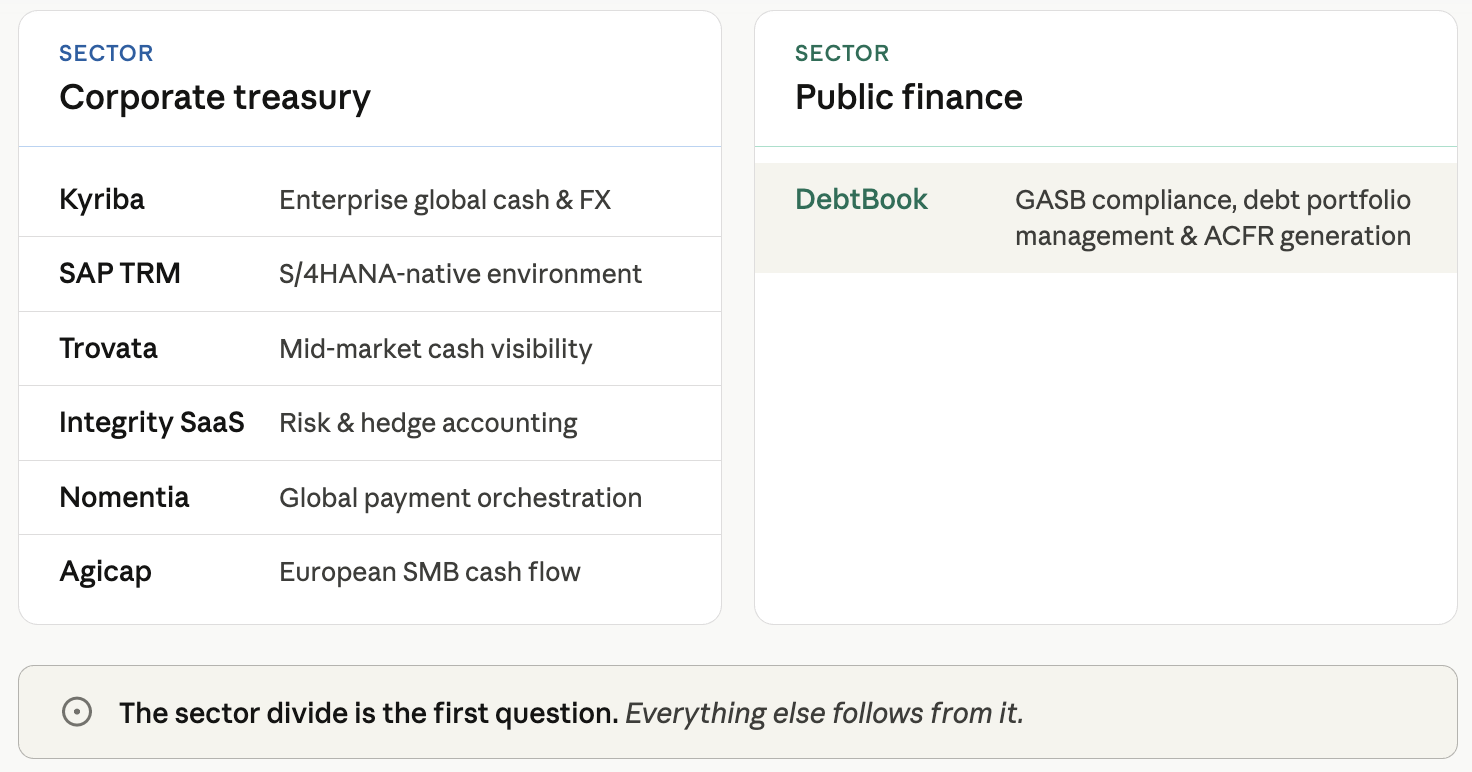
You’re searching for GTreasury alternatives, which means something isn’t working. Maybe the platform doesn’t speak your compliance language, the implementation never delivered on its promise, or your debt manager is retiring next year and you need a system that survives the transition. Whatever brought you here, the answer depends on one question: what sector do you operate in?
The treasury management market is crowded with platforms built for corporate finance teams managing global cash pools, FX risk, and payment networks. For organizations in state and local government, higher education, healthcare, and the nonprofit sector, that mismatch means evaluating tools that look right on paper but miss the workflows that consume most of your time: GASB compliance, debt portfolio tracking, and Annual Comprehensive Financial Report (ACFR) generation. A platform that automates cross-border payments but can’t produce an audit-ready footnote creates a different kind of problem.
The criteria that actually separate these platforms: public sector compliance depth, debt portfolio specificity, implementation burden, AI maturity, and key-person risk mitigation. Corporate treasury teams will find honest assessments of which tools serve their needs.
TL;DR
- Choose Monetary if your organization operates in state or local government, higher education, healthcare, or the nonprofit sector and needs native GASB compliance automation, debt portfolio management, and ACFR footnote generation built into the same platform.
- Choose Kyriba if you run enterprise corporate treasury operations with global cash pools, FX exposure, and complex payment networks that require connectivity to thousands of banks and ERPs.
- Choose Trovata if you lead a mid-market corporate treasury team that wants fast, modern multibank cash visibility without a months-long implementation.
- Choose SAP Treasury and Risk Management if your organization already runs SAP S/4HANA and needs treasury, cash, and payments unified inside that existing environment.
- Choose Integrity SaaS Treasury Management if your mid-to-enterprise organization needs broad treasury and risk functionality including hedge accounting within a single platform.
- Choose Nomentia if your global enterprise needs centralized payment orchestration across thousands of banks and currencies.
- Choose Agicap if you’re a European SMB or mid-market company managing multi-entity cash flow with a lean finance team.
Most treasury management tools are built for corporate finance. If your organization answers to GASB standards, manages a debt portfolio measured in hundreds of millions, and produces an ACFR, Monetary is the only platform in this set designed for that reality from the ground up.
Get a Demo of Monetary Today
Click HereThe best GTreasury alternatives at a glance
A quick look at the best GTreasury alternatives
| Tool |
Standout Feature |
Starting Price |
Best For |
| Monetary | Automated Long-Term Obligation Disclosure | Contact for pricing | Governments, higher education, healthcare, and nonprofits |
| Kyriba |
Agentic AI for cash forecasting | Custom pricing | Midsize to enterprise companies across industries |
| Treasury and Risk Manager – Integrity Edition | Treasury GPT | Custom pricing | Mid-sized to enterprise organizations with treasury needs |
| SAP Treasury and Risk Management | S/4HANA integration, AI reconciliation, hedge accounting audit trail | Custom pricing | Large and enterprise existing SAP customers |
| Trovata | Trovata AI | $24,000/year | Mid-market to enterprise treasury finance teams |
| Agicap | AI-Powered Transaction Categorization | Custom pricing | SMBs and mid-market companies across sectors |
| Nomentia | Payment Hub | Custom pricing | Mid-sized and large global enterprises |
What makes the best GTreasury alternatives?
The treasury management market divides along a line that most comparison guides never name: corporate finance and public finance operate under fundamentally different compliance regimes, and the tools built for one rarely serve the other well.
For corporate treasury teams, the critical capabilities are global cash visibility, FX risk management, payment automation, and bank connectivity at scale.
For public finance organizations managing government debt portfolios, the critical capabilities are automating GASB compliance, generating ACFR footnotes, tracking bond schedules, and preserving institutional knowledge before experienced staff retire.
Four criteria separate the platforms that fit public finance from those that do not. Public sector compliance depth comes first, followed by how specifically the platform handles debt portfolio management, how much implementation burden the team absorbs, and whether the AI addresses actual workflows today.
How we reviewed these tools
To evaluate the best GTreasury alternatives, we analyzed G2 reviews, official product websites, and publicly available pricing pages for each competitor in this set.
We assessed each platform against the criteria most relevant to treasury and finance professionals in state and local government, higher education, healthcare, and the nonprofit sector: compliance workflow automation, debt portfolio management depth, implementation complexity, AI capabilities, and fit for the public finance operating environment.
For Monetary, we conducted a hands-on product review and drew on documented customer outcomes from organizations including the City of Milwaukee, the City of Durham, and the City of Memphis.
Pricing information reflects what each vendor publicly discloses; where no pricing is published, we note that a sales conversation is required. Trovata is the only platform in this set with a published starting price of $24,000 per year.
Best for public finance organizations replacing legacy debt management systems with GASB-native compliance automation
Monetary
Best For: State and local governments, higher education, healthcare, and nonprofits managing complex debt portfolios
Pricing: Contact for pricing
Trusted by: City of Milwaukee, City of Memphis, City of Durham, UNC Charlotte
Monetary is a unified public finance platform covering debt, cash, leases, subscriptions, investments, and contracts in a single system. Every module is built around the workflows, compliance standards, and reporting structures of government and nonprofit finance, which means GASB 87, GASB 96, and ACFR generation are core to the platform’s design rather than features grafted onto a corporate treasury tool.
Where platforms like Kyriba and SAP Treasury and Risk Management are optimized for global cash pools, foreign exchange hedging, and enterprise payment networks, Monetary is optimized for bond schedules, refunding lineage, GASB compliance automation, and the audit workflows that define the public finance calendar.
Who should use Monetary?
Monetary fits treasury and accounting teams at state and local governments, public universities, healthcare organizations, and nonprofits that manage significant debt portfolios and face recurring GASB compliance obligations.
If your team currently tracks bond schedules in spreadsheets, spends weeks on ACFR footnote preparation, or carries key-person risk because one person understands the debt file, Monetary addresses all three problems directly. Organizations with variable-rate debt, complex refunding histories, or multi-departmental access requirements will find the platform’s depth particularly relevant.
The City of Memphis evaluated options to improve transparency and access to debt information, including state revolving fund loans and commercial paper, with visibility beyond the debt management team. Their assessment: Monetary “was what I envisioned, but actually a little bit more.”
Standout features
- Monetary’s AI Contract Processing extracts key contact data points for GASB 87 and GASB 96 compliance, eliminating manual data entry from the compliance workflow.
- Automated Long-Term Obligation Disclosure generates ACFR audit notes, debt outstanding summaries, and detailed roll-forward tables by activity and fund in a few clicks.
- True Lineage Refunding Tracking builds a complete lineage of every bond issue, tracing refundings down to the allocation level for audit-ready documentation.
How Monetary works
Monetary’s Debt Management module functions as a single source of truth for an organization’s entire debt portfolio. Treasury teams can track bond schedules, manage allocations, monitor payment activity, and build refunding lineage that traces every bond issue down to the individual allocation.
Variable Rate Debt Management automatically generates reset rates using market data integrations and identifies interest due for each reset and payment period, removing the manual calculation burden that trips up teams managing floating-rate obligations.
New Issue Structuring with Sizing lets treasury teams build scenarios, set structure and required proceeds, input interest payment details, and compare financing options before a bond goes to market, giving finance leaders a structured analytical tool rather than a spreadsheet model.
The compliance automation layer is where Monetary separates itself most clearly from every corporate treasury tool in this comparison. Accounting teams generate full and modified accrual journal entries and GASB-compliant footnote disclosures directly from the platform.
AI Contract Processing scans lease and subscription contracts to extract key data points, including terms, payment amounts, and commencement dates, feeding the GASB 87 and GASB 96 compliance workflows without manual re-entry. The City of Durham, NC reduced debt service budget preparation from a full day to 45 minutes after moving to Monetary, and when the city experienced a malware incident, its cloud-based architecture had the team back up and running, while the previous on-premise system offered little support.
Cash Management connects to financial institutions through secure bank APIs, pulling real-time transaction data into profiles and applying custom categorization rules automatically. Projected closing balances update in real time, and teams can build 13-month cash forecasts from the same interface.
Fraud Prevention and Bank Fee Analysis flags suspicious transactions and unusual outflows, and analyzes account analysis statements to surface potential overcharges, giving cash managers a layer of oversight that previously required manual review.
The platform operates on a cloud-based, unlimited-user model, which means access extends across departments, and auditors receive their own logins to retrieve debt documents and outstanding balances directly, reducing the bottleneck that forms when one person controls the data.
How much does Monetary cost?
Monetary does not publish pricing tiers. Pricing is determined through a custom quote based on the organization’s size, module selection, and portfolio complexity. No free trial is available, but Monetary offers a custom demo to walk through the platform’s capabilities against your specific workflows.
FAQ
Does Monetary offer a free trial?
No free trials are available, but Monetary would love to show you around in a custom demo tailored to your organization’s use case. Get a Demo to see the platform’s debt management, compliance automation, and cash management capabilities in the context of your workflows.
How does Monetary handle GASB 87 and GASB 96 compliance?
Monetary’s Lease Management module automates GASB 87 compliance for lease agreements covering buildings, equipment, vehicles, and land. Subscription Management handles GASB 96 obligations for subscription-based information technology arrangements, including project cost tracking for implementation costs.
Both modules use AI Contract Processing to extract key data points from contracts, then generate full and modified accrual journal entries and audit-ready footnote disclosures without manual re-entry. Accounting teams that previously spent weeks on annual compliance can complete the same work in a fraction of the time.
Is Monetary built for large or complex debt portfolios?
Monetary supports large, complex debt portfolios. The City of Milwaukee reduced a multi-day Tax Increment District management process to 30 minutes after evaluating five to six alternatives. This depth matters most for teams managing variable-rate debt, intricate refunding histories, or portfolios with private business use compliance requirements.
Best for enterprise corporate treasury at global scale
Kyriba
- Best For: Enterprise corporate treasury teams managing global cash, payments, and FX risk
- Pricing: Contact Kyriba for current pricing
- Free Trial: Not listed
Kyriba is a global liquidity performance platform serving 3,000 customers worldwide, processing more than $15 trillion in payments annually across 3 billion bank transactions. That scale reflects its core audience: large and mid-market corporate organizations in finance, technology, retail, manufacturing, and insurance that need a single platform to consolidate global cash positions, automate payments, and manage foreign exchange exposure.
The platform’s connectivity spans over 9,900+ bank connections, plus ERP and treasury system integrations (including SAP and Oracle Fusion), which gives enterprise teams a realistic path to replacing fragmented portals and spreadsheets with a unified operational picture.
Where Kyriba earns its reputation is in the breadth of its treasury function coverage. Real-time cash positioning, AI-powered liquidity forecasting through its dedicated agentic AI product TAI, payments automation with bulk processing capabilities, and structured approval hierarchies with segregation of duties are all available within one platform.
G2 reviewers highlight the ability to process up to 100 payments in a single batch as a concrete workflow improvement, and the platform’s enforcement of approval workflows gives treasury teams the internal controls that enterprise finance departments require. The tradeoff is implementation complexity: users consistently note that setup is time-consuming, requires specialized knowledge, and can increase dependency on external administrators or support resources.
Who should use Kyriba?
Kyriba fits enterprise and mid-market corporate treasury teams that operate across multiple banks, currencies, and geographies and need a platform that handles the full complexity of global liquidity management.
Organizations already running SAP or Oracle Fusion will find the integration path well-documented and user-validated. Treasury teams that process high volumes of payments daily, manage FX exposure, and need real-time visibility into liquidity across entities will get the most from the platform’s depth, provided they have the internal capacity or external support to manage a configuration-intensive implementation.
Standout features
- Kyriba’s TAI agentic AI product delivers real-time cash forecasting and liquidity scenario modeling across risk exposures.
- Connectivity to over 9,900 banks, ERPs, and treasury systems provides one of the broadest integration networks available in corporate treasury software.
- Structured payment automation with bulk processing, approval workflows, and segregation of duties supports enterprise-grade internal controls.
How Kyriba works
Kyriba connects to an organization’s banking infrastructure, ERP systems, and payment networks through its integration layer, pulling transaction data into a centralized cash position that updates in real time.
Treasury teams log into a single interface rather than cycling through multiple bank portals, and the platform applies configurable categorization rules and approval hierarchies to structure how cash movements are reviewed and authorized.
The result is a consolidated operational view of global liquidity that replaces the manual aggregation work that typically consumes treasury staff hours each morning.
The platform’s AI capabilities extend that foundation into forecasting. TAI, Kyriba’s agentic AI product, models liquidity scenarios and generates cash forecasts by analyzing transaction patterns and exposure data, giving treasury teams a forward-looking view alongside the real-time position.
Payments automation handles routine disbursements through bulk processing and automated reconciliation, reducing manual entry and the error risk that comes with it. For organizations managing FX exposure, the platform monitors currency positions and supports risk management workflows alongside the core cash and payments functions.
Where implementation demands attention is in configuration. G2 reviewers describe the setup process as requiring significant time and specialized knowledge, and some workflows depend on dedicated administrators to maintain.
Organizations evaluating Kyriba should factor in the internal resource commitment or external support budget that a full deployment requires, particularly if they are migrating from a simpler or more manual treasury environment.
How much does Kyriba cost?
Kyriba does not publish pricing publicly. Contact Kyriba directly for current pricing details.
FAQ
Q: How difficult is it to implement Kyriba, and what should organizations expect during setup?
Implementation is consistently described by G2 reviewers as time-consuming and configuration-intensive. The platform’s breadth means there are many modules and workflows to configure, and some organizations report needing specialized knowledge or external support to complete the setup properly.
Treasury teams should plan for a meaningful implementation timeline and assess whether they have the internal capacity or budget for external assistance before committing. Organizations with dedicated treasury IT resources or existing relationships with SAP or Oracle implementation partners will be better positioned to manage the process.
Q: Does Kyriba support public sector compliance requirements like GASB reporting or ACFR footnote generation?
Kyriba’s documented capabilities do not include GASB compliance workflows, ACFR footnote generation, or government fund accounting structures. The platform is designed for corporate treasury use cases across commercial industries, and its compliance features reflect that focus: hedge accounting audit trails, FX risk documentation, and payment controls built for corporate finance environments.
Organizations in state and local government, higher education, healthcare, or the nonprofit sector with GASB reporting obligations should evaluate platforms built specifically for those requirements.
Best for mid-to-enterprise corporate treasury and risk management
Integrity SaaS Treasury Management
- Best For: Mid-to-enterprise organizations managing complex treasury and hedge accounting needs
- Pricing: Contact FIS for current pricing
- Free Trial: Not listed
FIS Treasury and Risk Manager, Integrity Edition positions itself as a single path from basic cash positioning to the full complexity of hedge accounting, which means it can grow alongside an organization’s treasury requirements without requiring a platform change. The system automates core treasury functions, including cash flow documentation, investment schedule management, and amortization tracking for complex and dynamic portfolios.
Its Treasury GPT feature, an in-platform large language model, lets users query the system directly about configuration and operational practices, reducing the friction that typically accompanies onboarding and ongoing administration.
Where Integrity SaaS earns its credibility is in the depth of its risk and amortization capabilities. Users report that the platform handles complicated amortization schedules for company investments that would otherwise require manual tracking, and that its transaction records provide a reliable foundation for year-end audit preparedness.
That combination of operational efficiency and audit readiness makes it a credible option for treasury teams carrying significant investment complexity. The integration story is more complicated: G2 reviewers flag that connecting Integrity SaaS to external systems is “tricky” and “very difficult,” which matters for organizations expecting smooth ERP or bank connectivity from day one.
Who should use Integrity SaaS Treasury Management?
Integrity SaaS fits mid-to-enterprise corporate organizations that need a single platform spanning basic cash positioning and sophisticated hedge accounting, particularly those managing complex investment portfolios with dynamic amortization schedules.
Treasury teams that prioritize audit-ready transaction records and want an AI assistant for in-platform guidance will find the feature set well-matched to their needs. Organizations with significant corporate risk management requirements, including FX exposure and hedge strategy documentation, are the clearest fit.
Standout features
- Treasury GPT: An in-platform large language model that responds to queries about usability, configuration, and operational practices.
- Hedge accounting support: Manages the full complexity spectrum from basic cash positioning through compliant hedge accounting strategies.
- Complex amortization tracking: Automates dynamic amortization schedules for investment portfolios that are otherwise difficult to manage manually.
How Integrity SaaS Treasury Management works
FIS built Integrity SaaS around a core premise: treasury complexity should not require multiple platforms. The system handles the full range of corporate treasury functions within a single environment, connecting ERP systems, specialized financial systems, and FIS SWIFT Services through configured integrations.
Treasury GPT sits on top of that operational layer, giving users a conversational interface for configuration questions and workflow guidance rather than routing every query through a support ticket.
The platform’s investment management capabilities are where it differentiates most clearly from lighter-weight cash visibility tools. Integrity SaaS automates the investment schedules and amortization calculations that consume significant manual hours in organizations managing complex portfolios, and it maintains a transaction-level audit trail that supports year-end audit workflows.
For organizations managing both routine cash positioning and sophisticated risk instruments, those capabilities coexist in one system rather than requiring separate point solutions.
Integration is the area requiring the most planning. Connecting Integrity SaaS to external systems, including ERPs and bank platforms, has been described by G2 reviewers as technically demanding. Organizations evaluating the platform should factor in the internal technical resources or implementation support needed to establish those connections before go-live.
How much does Integrity SaaS Treasury Management cost?
FIS does not publish pricing for Integrity SaaS Treasury Management. Contact FIS directly for current pricing based on your organization’s size and requirements. G2 reviewers note that pricing can be a barrier for smaller or lower-margin organizations, which suggests the cost structure is calibrated toward mid-market and enterprise buyers.
FAQ
Q: Does Integrity SaaS Treasury Management support hedge accounting compliance documentation?
Yes. Hedge accounting is one of Integrity SaaS’s core capabilities, and the platform is designed to handle the full complexity spectrum from basic cash positioning through hedge strategy documentation. For organizations that need to manage FX exposure, interest rate risk, and compliant hedge accounting in a single system, this is one of the stronger options in the mid-to-enterprise corporate treasury market.
Q: How difficult is it to integrate Integrity SaaS with existing ERP systems?
FIS positions ERP and SWIFT integration as a configured capability, and the platform is designed to automate data flows between ERPs, specialized systems, and bank networks. In practice, G2 reviewers describe the process of connecting Integrity SaaS to external products as “tricky and very difficult,” so organizations should plan for dedicated technical resources during implementation rather than assuming a plug-and-play experience.
Best for large enterprises running SAP S/4HANA
SAP Treasury and Risk Management
- Best For: Large enterprises already committed to the SAP S/4HANA environment
- Pricing: Contact SAP for current pricing
- Free Trial: Not listed
SAP Treasury and Risk Management is delivered as a module within SAP S/4HANA Cloud. For organizations already running SAP ERP, that architecture is a genuine strength: cash management, forecasting, and payments unify in a single system rather than requiring a separate integration layer.
The platform automates bank statement reconciliation using AI, generates cash positions from integrated data sources, and maintains full audit trails for hedge accounting strategies, giving enterprise treasury teams a unified view of liquidity and financial risk without leaving the SAP environment.
Where SAP Treasury and Risk Management earns its reputation is in financial risk management depth. The platform monitors risk positions and currency conversion rates to support compliant hedge accounting strategies, a capability that corporate treasury teams managing FX exposure and complex borrowing structures rely on. U
sers on G2 consistently describe the platform as reliable and well-optimized for operational treasury problems, particularly when the underlying SAP infrastructure is already in place. The trade-off is that this depth comes with significant setup complexity: reviewers describe initial configuration as requiring careful planning and specialized technical expertise, and some modules feel less modern than newer treasury tools built on contemporary UI frameworks.
Who should use SAP Treasury and Risk Management?
SAP Treasury and Risk Management fits large enterprise organizations already running SAP S/4HANA that need native integration between treasury operations, cash forecasting, and financial risk management.
It’s particularly well-suited to organizations with dedicated IT resources and treasury teams managing FX exposure, hedge accounting, and complex borrowing structures across multiple entities. If your organization has already committed to the SAP environment and needs treasury functionality that operates within that infrastructure rather than alongside it, this is the logical choice.
Standout features
- Native SAP S/4HANA integration unifies cash management, forecasting, and payments in one environment without a separate integration layer.
- Hedge accounting audit trail monitors risk positions and currency rates to support compliant FX risk management strategies.
How SAP Treasury and Risk Management works
SAP Treasury and Risk Management operates as an integrated module within SAP S/4HANA Cloud, so the platform’s core advantage is that treasury data lives in the same system as the broader enterprise financial record.
Cash positions are generated automatically from integrated sources, bank statement reconciliation runs through AI-assisted processing, and payments are confirmed through two-way integration with multiple trading platforms. For organizations already in the SAP environment, this architecture eliminates a category of data synchronization problems that standalone treasury tools typically require middleware to solve.
The financial risk management capabilities follow the same integrated logic. The platform monitors FX exposure and interest rate risk, supports hedge accounting strategies with structured audit trails, and enables liquidity scenario modeling alongside cash forecasting. These are capabilities built for corporate treasury teams managing complex borrowing structures and currency risk across global operations.
The implementation reality, however, deserves honest attention. G2 reviewers consistently note that configuration requires significant technical expertise and careful planning, and that some modules still require manual data aggregation despite the platform’s automation features. Organizations without dedicated SAP administrators or IT resources to support the initial build should factor that resource requirement into any timeline estimate.
How much does SAP Treasury and Risk Management cost?
SAP does not publish pricing for Treasury and Risk Management. Contact SAP directly for current pricing based on your organization’s size, existing SAP licensing, and the specific modules required.
FAQ
Q: Does SAP Treasury and Risk Management work if my organization doesn’t already use SAP S/4HANA?
SAP TRM requires an SAP ERP backbone. Organizations not on SAP S/4HANA could deploy it on SAP ECC or migrate to S/4HANA, but it is never a standalone product. A non-SAP shop would not deploy TRM in isolation. Organizations without an existing SAP environment should expect substantially higher implementation complexity and cost, since they would effectively be adopting two interconnected systems rather than extending one.
Q: How does SAP Treasury and Risk Management handle hedge accounting compliance?
The platform maintains a full audit trail for hedge accounting strategies, monitoring risk positions and currency conversion rates to support compliant FX risk management. This is one of the capabilities that enterprise treasury teams with complex FX exposure specifically seek out in SAP’s platform.
The audit trail documentation is built into the workflow rather than generated as a separate export, which supports both internal controls and external audit requirements for organizations managing significant currency risk across multiple entities.
Best for real-time corporate cash visibility without heavy IT involvement
Trovata
- Best For: Mid-market treasury teams wanting fast, modern multibank cash visibility
- Pricing: Starting at $24,000/year, billed annually
- Free Trial: Not listed on pricing page
Trovata is a modern cash management platform built to replace the daily ritual of logging into multiple bank portals and manually consolidating balances into a spreadsheet. It connects directly to banks via API and pulls transaction data continuously into a single view, so treasury teams get real-time cash positioning across entities without IT configuring or maintaining the connections.
Built on that data foundation, Trovata AI adds three capabilities: Chat handles natural language Q&A against your cash data, Insights surfaces anomalies proactively, and Agents schedule recurring automation tasks.
Where Trovata earns its reputation is in the speed of that visibility. Corporate treasury teams managing cash across multiple banks and legal entities can see consolidated positions, run ad-hoc transaction searches, and generate reports without the manual aggregation work that consumes hours in legacy environments.
The platform also executes payments natively, supporting RTP, ACH, and wire transfers through direct bank API connections rather than routing through third-party payment vendors, which matters for teams that want to consolidate cash visibility and payment execution in one place.
Who should use Trovata?
Trovata fits mid-market to enterprise corporate treasury teams whose primary challenge is multibank cash visibility and reporting. It’s particularly well-suited to lean treasury functions where IT resources are limited, since the platform is designed for setup without heavy technical involvement.
Organizations managing cash across multiple banks and entities, running frequent ad-hoc reporting, and looking to automate recurring treasury tasks through AI-driven scheduling will find Trovata’s feature set closely matched to those workflows. The published starting price of $24,000 per year also gives budget-conscious teams a concrete number to evaluate before entering a sales conversation.
Standout features
- Trovata AI delivers three production-ready capabilities: natural language cash Q&A, proactive anomaly detection, and scheduled automation agents.
- Native payments execution supports RTP, ACH, and wire transfers directly through bank APIs, eliminating reliance on third-party payment vendors.
- Multibank data aggregation connects, normalizes, and continuously refreshes bank data across institutions into a single consolidated cash position.
How Trovata works
Trovata’s architecture starts with direct bank API connections that pull transaction and balance data continuously, normalizing it across institutions so the platform always reflects current positions rather than yesterday’s export.
Once the data foundation is established, treasury teams work from a single portal instead of rotating through individual bank interfaces, with all balances and transactions searchable and reportable from one place. The setup is designed to minimize IT dependency, which shortens the path from contract to working dashboard compared to platforms that require significant technical configuration.
The AI Suite layers onto that data foundation in three distinct modes. AI Chat lets users ask questions in natural language and receive answers drawn from live transaction data. AI Insights monitors for patterns and anomalies proactively, surfacing exceptions before a user thinks to look for them.
AI Agents handle scheduled automation: recurring reports, routine data pulls, and other repeating tasks that would otherwise consume analyst time. Together, these capabilities represent a coherent AI strategy rather than a single feature bolted onto a legacy platform.
Payments execution is integrated directly rather than handled through a separate vendor. Trovata supports real-time payments, ACH, and wire transfers through the same bank API connections that power cash visibility, so teams can act on their cash position without switching platforms.
For treasury functions that currently manage visibility in one tool and payments in another, this consolidation reduces both operational complexity and the reconciliation work that comes from maintaining parallel systems.
How much does Trovata cost?
Trovata publishes its starting price, which is $24,000 per year, billed annually. The entry tier includes one bank connection, 100 accounts, one million transactions, and ten users. Enterprise pricing is available on a custom basis. Contact Trovata directly or visit their pricing page for current plan details and higher-tier options.
FAQ
Q: How difficult is Trovata to configure for a team without dedicated treasury technology resources?
Trovata is designed to reduce IT dependency, and reviewers generally describe the interface as intuitive once the platform is running. That said, the initial configuration of data streams and the transaction tagging system carries a noted learning curve, with some users describing the setup process as requiring meaningful time investment before the platform delivers its full value. Teams without a dedicated treasury analyst or someone willing to invest in that configuration phase should factor that ramp into their evaluation timeline.
Q: Does Trovata support cash flow forecasting, and how customizable are those forecasts?
Trovata includes cash flow forecasting capabilities built on its real-time bank data foundation. However, some reviewers have flagged the forecasting tools as limited in customization, noting that the current feature set doesn’t fully accommodate the range of scenarios or forecast structures they need. Teams with straightforward forecasting requirements are likely to find the functionality sufficient, while those with complex multi-entity or multi-currency forecasting needs should test those workflows specifically during a proof-of-concept evaluation.
Best for European SMB and mid-market cash flow management
Agicap
- Best For: European SMBs and mid-market companies managing multi-entity cash flow
- Pricing: Contact Agicap for current pricing
- Free Trial: Not listed on pricing page
Agicap is a European cash flow management platform serving over 8,000 clients across 12 countries, built around the operational reality of finance teams managing multiple entities, currencies, and bank accounts from a single interface. Its core strength is accessibility: the platform connects to banks and ERP systems via Open Banking APIs, automates transaction categorization using AI, and presents cash positions through visual dashboards that reviewers consistently describe as intuitive even for non-financial profiles.
Rolling 13-week cash flow planning tools let teams build and adjust forecasts quickly, and OCR-based accounts payable automation with approval workflows extends the platform’s reach into supplier invoice processing.
Where Agicap draws its clearest boundaries is in geographic and organizational scope. The platform is designed for European commercial organizations, and its feature set reflects that context: multi-currency aggregation, Open Banking API connectivity calibrated to European banking infrastructure, and AP automation workflows suited to commercial invoice processing.
Agicap’s documented capabilities do not include GASB compliance workflows, debt portfolio management, or government audit note generation. Organizations operating outside Europe or requiring public-sector accounting standards will find the platform’s architecture points in a different direction.
Who should use Agicap?
Agicap fits European SMBs and mid-market companies whose primary treasury challenge is consolidating cash visibility across multiple entities and bank accounts. Finance teams that spend significant time logging into separate banking portals, manually reconciling multi-currency positions, or routing supplier invoices through disconnected approval chains will find the platform’s Open Banking connectivity and AP automation directly address those friction points. Organizations with a lean treasury function that need forecasting and cash monitoring without a heavy implementation lift are the clearest fit.
Standout features
- AI-powered transaction categorization automatically matches bank transactions with invoices across multiple entities and currencies.
- OCR-based accounts payable automation processes supplier invoices with approval workflows and automated payment execution.
- Open Banking API connectivity aggregates and synchronizes multi-currency cash positions across banks and ERP systems in real time.
How Agicap works
Agicap connects to a company’s banks and ERP systems through Open Banking APIs, pulling transaction data automatically and normalizing it across entities and currencies into a single cash management view. AI-powered categorization applies to incoming transactions. It matches bank activity against invoices and flags items that need attention, which reduces the manual reconciliation work that consumes time in multi-entity finance teams. The platform’s visual dashboards present consolidated positions in a format designed for fast interpretation, a deliberate choice that extends usability beyond treasury specialists to broader finance and management stakeholders.
From that cash visibility foundation, Agicap extends into forecasting and payables. The rolling 13-week planning tools let teams build short- and medium-term cash projections and adjust them as conditions change, with the goal of supporting faster decisions on liquidity. The accounts payable module adds OCR-based invoice capture, approval routing, and payment execution, bringing supplier payment workflows into the same platform rather than leaving them in disconnected systems.
Reviewers note that the centralization of multiple entities into one view is where the platform delivers its most tangible value, particularly for fund managers and holding structures overseeing a range of operating companies.
How much does Agicap cost?
Agicap does not publish pricing publicly. Contact Agicap directly for current plan pricing and details.
FAQ
Q: How long does Agicap’s onboarding typically take, and what does setup involve?
Reviewers on G2 describe the initial setup as complex and time-consuming, with multiple meetings required to align the platform’s configuration to specific company needs. The process involves connecting bank accounts via Open Banking APIs, integrating with ERP systems, and establishing categorization rules and approval workflows.
Agicap’s support team receives consistent praise for responsiveness during this period, which reviewers credit with making the onboarding manageable despite its complexity. Organizations with a lean finance team should factor implementation time into their evaluation timeline.
Q: Does Agicap support multi-currency and multi-entity treasury management?
Multi-entity and multi-currency cash centralization is one of Agicap’s primary strengths. The platform connects to banks across multiple countries via Open Banking APIs, aggregates positions in different currencies, and presents consolidated views across entities in a single interface.
Reviewers managing dozens of bank accounts across varied legal structures describe this consolidation capability as the feature that most directly addresses their operational challenge. Organizations with complex European holding structures or subsidiaries operating across multiple currencies are the clearest fit for this capability.
Best for global enterprise payments and multi-bank connectivity
Nomentia
- Best For: Global enterprises centralizing cross-border payments, FX risk, and multi-bank connectivity
- Pricing: Contact Nomentia for current pricing
- Free Trial: Not listed on pricing page
Nomentia is a modern SaaS cash and treasury management platform serving over 1,400 companies across more than 80 countries. Its core strength is payment orchestration at scale: a centralized payment hub that connects ERPs, financial systems, and banks to automate local, cross-border, and global payments from a single point.
That connectivity extends to over 10,000 banks globally, with fully managed connections and file format conversions that reduce the technical burden on treasury teams handling diverse banking relationships. The platform also provides real-time cash visibility across 2,500-plus banks and applies machine learning to develop cash flow forecasts automatically.
Where Nomentia earns its strongest reviews is in FX automation and transparency. Users credit the platform with reducing the manual Excel management that typically accompanies foreign exchange exposure tracking, and the customizable payment approval workflows accommodate the complex group structures that large global enterprises operate within.
Who should use Nomentia?
Nomentia fits mid-sized to large enterprises that manage significant global payment volumes across multiple banks, currencies, and legal entities. Organizations with complex FX exposure, cross-border payment workflows, and a need to harmonize payment approvals across a large group structure will find the platform’s payment hub and risk management capabilities directly relevant. It suits treasury teams that have outgrown legacy systems and want a cloud-based alternative with broad bank connectivity and managed format conversions, without requiring the implementation footprint of a platform like SAP Treasury and Risk Management.
Standout features
- Nomentia’s payment hub centralizes local, cross-border, and global payments across ERPs, financial systems, and banks in one workflow.
- Bank connectivity spans over 10,000 institutions globally, with fully managed connections and automated file format conversions.
How Nomentia works
Nomentia’s payment hub sits at the center of the platform, pulling together connections from ERP systems and financial platforms to route payments through a single, controlled channel. Cash visibility and risk management build on that foundation. This architecture is designed to eliminate the fragmented payment workflows that emerge when large organizations manage dozens of banking relationships independently, each with its own format requirements and approval processes.
Cash visibility works through Nomentia’s bank connectivity layer, which aggregates real-time positions across a broad network of financial institutions. The platform applies machine learning to that consolidated data to generate cash flow forecasts, reducing the manual effort of pulling and reconciling bank data from multiple sources. For organizations managing cash across multiple currencies and geographies, this real-time aggregation is the operational foundation everything else builds on.
The FX and risk management module extends that visibility into exposure management, giving treasury teams a structured process for identifying key risk drivers and implementing hedging strategies. Users can track FX exposure across the portfolio and automate core hedging processes, replacing the manual spreadsheet workflows that introduce both errors and delays. Together, these three layers form a connected treasury workflow rather than a collection of standalone tools.
How much does Nomentia cost?
Nomentia does not publish pricing publicly. Contact Nomentia directly for current pricing details specific to your organization’s size, bank connections, and module requirements.
FAQ
Q: How difficult is Nomentia to configure and maintain after implementation?
Nomentia users consistently describe the initial implementation as faster and more intuitive than legacy treasury systems, and the HTML5 interface earns strong marks for day-to-day usability. That said, G2 reviewers note that parameter settings and mapping tables can become complex as configurations grow, and some users feel the platform’s guidance for those configurations is insufficient. Organizations with dedicated treasury operations staff or an implementation partner will be better positioned to manage ongoing configuration than lean teams without that internal expertise.
Q: Does Nomentia support advanced reporting and analytics out of the box?
Nomentia provides predefined report structures for standard treasury reporting needs. However, users who require advanced functionality, specifically the ability to pivot data in Excel downloads, have noted that this capability requires an additional upcharge rather than being included in the base platform. Organizations with complex, ad hoc reporting requirements should clarify exactly which reporting features are included in their specific contract before signing, to avoid discovering that the analysis workflows they rely on carry additional cost.
Why Monetary is the best GTreasury alternative for public finance organizations
If your organization adheres to GASB standards, manages a complex debt portfolio, and produces an ACFR, Monetary is the only platform in this set built for that reality from the ground up.
Get a Demo of Monetary
Click HereDisclaimer
The information provided in this article is accurate at the time of publication in 2026. Product features, pricing, and availability are subject to change. We recommend verifying current details directly with each vendor before making a purchasing decision. Competitor information is sourced from G2 reviews, official product websites, and publicly available pricing pages.
Related Treasury Management Reading
- Modernize Your Treasury Management Operations Through AI and Automation- Without Losing Control
- [Survey] The Biggest Priorities (& Barriers ) Facing Public Finance Leaders Today
- 6 Ways to Ensure Your Treasury Spend Can Withstand Audit and Oversight
Disclaimer: Monetary does not provide professional services or advice. Monetary has prepared these materials for general informational and educational purposes, which means we have not tailored the information to your specific circumstances. Please consult your professional advisors before taking action based on any information in these materials. Any use of this information is solely at your own risk.
Best Treasury Management Systems: We Reviewed 7 – Here’s Our Pick
Most treasury management systems can show you a cash position. The question that separates them is what happens next: whether the platform connects that position to a debt service schedule, routes it into a rolling forecast, and generates the ACFR footnotes your auditor needs, all without a spreadsheet in between.
For public finance teams, the right treasury management system is the one that scores highest across four specific criteria: public finance specificity, platform breadth, compliance workflow automation, and institutional knowledge preservation.
Every tool in this guide is evaluated against those four pillars, and the ranking that follows reflects how each platform performs on them.
TL;DR
• Choose Monetary if your organization is a state or local government, higher education institution, healthcare organization, or nonprofit that needs GASB 87 and GASB 96 compliance automation, debt portfolio management, and cash positioning in one purpose-built platform.
• Choose Kyriba if you’re a large multinational corporate managing FX risk, global liquidity, and payments across 9,900+ bank connections.
• Choose Ripple Treasury if you’re a Fortune 500 enterprise treasury team that needs AI-driven cash visibility and digital asset infrastructure deployed quickly.
• Choose Trovata if your primary need is fast, API-first multibank cash visibility at a transparent starting price of $24,000/year.
• Choose HighRadius if you’re a large B2B enterprise automating order-to-cash and accounts receivable at scale.
• Choose FIS Integrity if you’re a large corporate with complex global cash, payments, and risk management requirements.
• Choose Coupa if your focus is procurement, invoicing, and total spend management rather than treasury and debt operations.
The bottom line: Every corporate TMS on this list can show you a cash position. Only Monetary connects that cash position to your debt service schedule, generates your ACFR footnotes, and automates GASB 87 and GASB 96 compliance, without a single spreadsheet in between.
Get a Demo of Monetary Today
Click HereWhat makes the best treasury management system?
Most “best TMS” guides evaluate tools through a corporate finance lens: multi-currency cash pooling, FX hedging, global payment hubs, etc.
For treasury and accounting teams at state and local governments, higher education institutions, healthcare organizations, and nonprofits, those criteria are often irrelevant.
The real questions are whether a platform automates GASB 87 and GASB 96 compliance, generates ACFR footnotes without a time consuming manual process, tracks debt refunding lineage down to the allocation level, and preserves institutional knowledge when a key person retires.
Four criteria separate the tools that actually meet buyer requirements
- Public finance specificity: Does the platform support GASB 87 and GASB 96 compliance workflows, ACFR footnote generation, variable rate debt management, and IRS private business use tracking, or does it require workarounds to approximate these functions?
- Platform breadth: Does the system unify debt management, cash positioning, lease and subscription compliance, investment management, and contract management in one place, or does it solve one problem while leaving the others to spreadsheets?
- Compliance workflow automation: Does the platform generate journal entries, audit footnotes, and filing schedules automatically, or does it store data that staff must still manually format for auditors?
- Institutional knowledge preservation: Does the system eliminate key-person risk through cloud-based access, unlimited users, and complete audit trails, so that the workflows survive when experienced staff retire?
How we reviewed these tools
We evaluated seven treasury management systems against the criteria above, drawing on official product documentation, pricing pages, and G2 and Capterra user reviews for each competitor.
Competitor strengths and limitations are sourced directly from verified user reviews and official websites.
For Monetary, we conducted a hands-on product review and analyzed documented customer outcomes across multiple public finance organizations.
We weighted public finance specificity and compliance automation most heavily, because those criteria determine whether a platform actually fits this buyer’s operational reality. Tools that excel for corporate treasury teams are evaluated on their own terms and recommended honestly for the buyers they serve.
Monetary
Best For: State and local governments, higher education institutions, healthcare organizations, and nonprofits managing debt portfolios, GASB compliance and cash positioning.
Pricing: Contact for pricing
Trusted by: City of Milwaukee, City of Memphis, Town of Granby, Vermont Bond Bank
Every module in Monetary reflects how government, higher education, healthcare, and nonprofit organizations actually operate: debt service schedules, GASB 87 and GASB 96 compliance automation, Annual Comprehensive Financial Report (ACFR) footnote generation, and variable rate debt management are core functionality, not add-ons adapted from a corporate treasury tool.
The six modules (Debt Management, Cash Management, Investment Management, Lease Management, Subscription Management, and Contract Management) operate on a single platform where data flows between functions natively, so debt service payments feed into cash forecasts without a manual export in between.
The platform was designed around a structural problem that every public finance team recognizes: institutional knowledge concentrated in one person, one spreadsheet, or one legacy system that only a specialist can navigate.
Monetary’s cloud-based architecture with unlimited users eliminates that bottleneck. When a key person retires, the data stays, the audit trail stays, and the workflows stay, accessible to every authorized team member without a license restriction or a specialized training requirement.
Who should use Monetary?
Treasury managers, debt managers, cash managers, finance directors, and comptrollers at state and local governments, higher education institutions, healthcare organizations, and nonprofits should evaluate Monetary. It fits organizations that manage a debt portfolio alongside lease compliance and cash positioning, particularly those currently working in spreadsheets or a legacy system that requires specialized knowledge to navigate.
Standout features
- AI Contract Processing scans lease contracts for lease terms, payment amounts, and commencement dates, and scans subscription contracts for subscription terms, payment schedules, and implementation costs, surfacing suggested inputs for user review before any data is committed.
- Automated Long-Term Obligation Disclosure generates ACFR audit notes in a handful of clicks and exports formatted Excel roll-forward tables, reducing what once took days to a short task.
- Variable Rate Debt Management auto-generates reset rates through market data integrations, benchmarks against SIFMA and SOFR, and identifies interest due (including liquidity and remarketing fees) for each reset and payment period.
How Monetary works
Monetary’s primary differentiator is the depth of integration across functions that public finance teams actually use together. Debt service schedules connect to cash flow forecasts. Lease and subscription compliance workflows feed into journal entry generation on both modified and full accrual bases. ACFR footnotes pull from live portfolio data rather than a manually assembled spreadsheet.
The City of Memphis centralized $2B in outstanding debt, including state revolving fund loans and commercial paper, into a single cloud-based source of truth after years of searching for a solution transparent enough to give access beyond the debt management team alone.
The debt management module covers the full lifecycle of a bond issue.
New Issue Structuring lets treasury teams build multiple financing scenarios before going to market, comparing required proceeds, coupon rates, and expenses side by side.
True Lineage Refunding Tracking follows each refunding down to the allocation level, showing which original issues were retired and what replaced them.
Bond Proceeds Management centralizes project-related spending data across one or more bond series.
For organizations subject to IRS scrutiny, the Private Business Use tracking hub manages project information and tracks private use by time, revenue, space, or other units to support tax compliance.
Financial Reporting standardizes recurring reports and manages continuing disclosure agreements in a central repository, with AI-assisted setup and auto-generated filing schedules that reduce the manual coordination burden.
Cash Management operates through secure API connections to financial institutions, pulling real-time transaction data throughout the day and updating projected closing balances on a continuous basis. Rule-based fraud detection flags suspicious transactions automatically, such as individual outflows above a specified threshold or check outflows from receivables-only accounts, reducing fiduciary risks.
Bank Fee Analysis surfaces discrepancies between contracted and charged prices by uploading account analysis statements, a capability that rarely appears in corporate treasury tools and reflects Monetary’s focus on the specific operational realities of public finance.
The City of Milwaukee reduced a multi-day manual debt allocation process across 117 tax increment districts to 30 minutes, replacing a legacy system that required specialized knowledge to navigate and that concentrated institutional risk in a small number of staff.
FAQ
Q: Does Monetary offer a free trial?
No free trials are available, but Monetary offers a custom demo tailored to your organization’s workflows and data. For public finance teams evaluating a platform for the first time, a configured demo is more useful than a generic trial environment because it shows how the system handles your specific debt types, compliance requirements, and reporting needs.
Q: Is Monetary built for small governments and nonprofits, or only large organizations?
Both. The platform scales from small towns to large cities managing multi-billion-dollar portfolios.
Q: How does Monetary handle GASB 87 and GASB 96 compliance?
Monetary’s Lease Management module is purpose-built for GASB 87 (government lease accounting) and its Subscription Management module addresses GASB 96 (subscription-based information technology arrangements, or SBITAs).
Both automate compliance workflows including journal entry generation, audit footnote exports, and modification tracking. Organizations that previously spent weeks on annual compliance reporting can complete the same work in a handful of clicks with Monetary.
Ripple Treasury (powered by GTreasury)
- Best For: Enterprise corporate treasuries managing global cash across multiple entities and currencies.
- Pricing: Custom pricing, contact Ripple Treasury for current pricing
- Free Trial: Not listed on pricing page
Ripple Treasury, powered by GTreasury, is an enterprise treasury management system that combines cash visibility, payments, risk management, and AI-driven analytics in a single platform. The company serves over 1,000 customers across 160 countries, positioning itself at the mid-market to Fortune 500 range, from organizations implementing their first TMS to multinationals managing complex global operations.
Its acquisition by Ripple added native digital asset infrastructure, making it one of the few TMS platforms that can consolidate fiat and digital liquidity in one view without requiring a separate custody platform.
The platform’s core value proposition is speed and connectivity: cash visibility deployable in 90 days, extensive bank and ERP integrations, and GSmart AI that surfaces anomalies and produces executive-ready analysis across core treasury workflows.
For corporate treasury teams managing multi-entity cash positions, FX exposure, and global payments, Ripple Treasury covers the essential workflows in one system. Its documented capabilities do not include GASB 87 or GASB 96 compliance automation, ACFR footnote generation, or public finance debt management workflows.
Who should use Ripple Treasury?
Ripple Treasury suits corporate treasury teams at mid-market to large enterprises that need fast, centralized cash visibility across multiple banks, entities, and currencies. Organizations that have outgrown spreadsheet-based cash positioning and need a platform with strong ERP connectivity, payments orchestration, and AI-assisted forecasting will find it well-matched to their requirements.
It’s particularly relevant for teams that manage or anticipate managing digital assets alongside traditional fiat liquidity, since that capability is built into the platform rather than bolted on.
Standout features
- GSmart AI surfaces hidden insights and detects anomalies across core treasury workflows, producing executive-ready analysis to improve forecast accuracy.
- Native digital asset infrastructure delivers a single real-time view of fiat and digital liquidity held across bank and custody providers, eliminating separate platforms.
- Cash visibility deployment is structured for a 90-day go-live, with broad connectivity across banks and ERPs to build an orchestrated data environment.
How Ripple Treasury works
Ripple Treasury is built around a centralized data environment that pulls cash positions, transactions, and financial instrument data from banks and ERPs through direct integrations. Once connected, the platform updates cash positions throughout the day, allowing treasury teams to see consolidated balances across all entities without logging into individual bank portals.
GSmart AI runs continuously across this data, flagging anomalies and generating analysis that treasury managers can surface to senior leadership without additional manual preparation.
The platform organizes treasury work across several interconnected function areas:
- Cash visibility and forecasting: Real-time position management across all accounts and entities, with short and long-term forecasting that incorporates payments from financial instruments
- Payments and connectivity: Centralized payment execution with bank and ERP orchestration across the organization’s full financial infrastructure
- Digital asset management: Unified fiat and digital liquidity view across bank and custody providers, removing the need for a separate digital asset platform
- AI-assisted analysis: GSmart AI detects anomalies, surfaces insights, and generates analysis across core treasury workflows
Ripple Treasury’s connectivity model is designed for organizations with complex multi-bank, multi-entity structures. Implementations are described as running in weeks for connectivity setup, with full cash visibility targeted at 90 days.
Users cite the centralization of operations across multiple institutions as the platform’s most practical day-to-day strength, though some note that the reporting module and error resolution workflows require more manual effort than the rest of the platform suggests.
FAQ
Q: How long does it take to implement Ripple Treasury and see cash visibility?
Ripple Treasury markets a 90-day deployment timeline for cash visibility, with connectivity setup described as running in weeks. This is a marketing claim from the official website rather than a figure drawn from independent user validation, so actual timelines will vary based on the number of bank connections, ERP integrations, and entities involved. Organizations with complex multi-entity structures should plan for a scoping conversation before committing to any specific timeline.
Q: Does Ripple Treasury’s reporting module meet the needs of teams with complex reporting requirements?
User reviews on G2 consistently flag the report writer as one of the platform’s weaker areas, describing it as lacking ease of use and unintuitive for users who are new to the system. Teams with straightforward reporting needs are unlikely to find this a significant barrier, but organizations that require highly customized or ad hoc reports should evaluate the reporting module directly during a demo before committing.
Some users also note that templates for updating large data sets are difficult to navigate, which can add friction to workflows that depend on bulk data management.
Kyriba
- Best For: Enterprise finance teams managing global liquidity, FX risk, and payments across multiple entities.
- Pricing: Contact Kyriba for current pricing
- Free Trial: Not listed on pricing page
Kyriba is a global liquidity performance platform serving 3,000 customers worldwide, built for CFOs and treasurers who need to unify treasury, risk, payments, connectivity, and working capital on a single interface.
Its connectivity to over 9,900 banks, as well as ERPs, and payment systems, is one of the most extensive in the category, giving multinational organizations the ability to consolidate liquidity data across banks and countries automatically rather than through manual feeds.
The platform’s TAI, Kyriba’s agentic AI layer adds real-time cash, liquidity, and exposure forecasting across risk scenarios, which serves organizations managing complex FX positions and multi-currency cash pools.
Kyriba’s strongest differentiator is the depth of its corporate treasury automation: bulk ACH processing, automated general ledger booking, wire generation, and ERP integration with SAP and Oracle Cloud.
Reviewers on G2 consistently cite the ability to manage daily liquidity management and payment execution from a single interface as a genuine improvement over logging into multiple bank portals. The platform’s configuration demands are significant. Users report that setup is long and complex, requiring substantial support before the system is fully operational, and that some configurations require specialized knowledge to maintain over time.
Who should use Kyriba?
Kyriba fits large enterprises with complex, multi-entity treasury operations: organizations managing FX exposure, cross-border payments, and liquidity across dozens of banking relationships simultaneously.
Finance teams at midsize-to-enterprise companies in technology, manufacturing, retail, and financial services will find the platform’s bank connectivity breadth and risk management depth well matched to their operational scope. Organizations that already run SAP or Oracle Cloud will benefit most from Kyriba’s ERP integration, which automates journal entry posting and bank reporting in ways that reduce manual reconciliation at scale.
Standout features
- TAI, Kyriba’s agentic AI forecasts real-time cash, liquidity, and FX exposures across multiple risk scenarios simultaneously.
- 9,900+ bank connections automatically unify liquidity data across global banking relationships and financial systems.
- Automated payments processing handles bulk ACH uploads, GL booking, and wire generation from a single treasury interface.
How Kyriba works
Kyriba connects to an organization’s banking and ERP infrastructure through its connectivity layer, pulling transaction data and balance information from over 9,900 institutions to build a consolidated cash position.
From that unified data foundation, the platform runs treasury, risk, and payments workflows in a single interface: cash positioning, FX exposure management, payment execution, and working capital analytics all draw from the same consolidated database rather than separate siloed systems.
The TAI Agentic AI layer operates on top of that data, generating forecasts and surfacing exposure scenarios that inform liquidity decisions. For organizations with complex FX risk or multi-entity cash structures, this means treasury teams can model scenarios and stress-test positions without exporting data into external tools.
The ERP integration with SAP and Oracle Cloud closes the loop by posting journal entries and bank reconciliations automatically, reducing the manual handoff between treasury and accounting.
Kyriba’s documented capabilities do not include GASB 87 or GASB 96 compliance workflows, ACFR footnote generation, or public finance debt management features such as bond refunding lineage tracking or variable rate reset automation.
FAQ
Q: How long does Kyriba implementation typically take?
Kyriba’s implementation timeline varies by organizational complexity, but G2 reviewers consistently describe the setup process as long and configuration-intensive, requiring significant support before the platform is fully operational.
Organizations with complex multi-entity structures or extensive ERP integration requirements should plan for a substantial implementation phase and budget for configuration support, particularly if internal IT resources are limited.
Q: Does Kyriba support FX risk management alongside cash management?
Yes. Kyriba’s risk management module covers FX exposure, debt, investments, and interest rate risk within the same platform as cash and payments. This is one of Kyriba’s core differentiators for multinational organizations: treasury teams can manage currency exposure and execute hedging workflows without switching to a separate risk system. The TAI Agentic AI layer extends this by modeling exposures across multiple risk scenarios in real time.
Trovata
- Best For: Mid-market finance teams needing fast, transparent-priced multibank cash visibility.
- Pricing: Starting at $24,000/year
- Free Trial: Not listed on pricing page
Trovata is an AI-powered bank connectivity platform that replaces legacy bank portals and disconnected treasury management systems by pulling real-time financial data from hundreds of banks through open banking APIs and direct SWIFT connectivity.
Where many treasury platforms require months of configuration before delivering usable cash visibility, Trovata centers its value proposition on speed to insight: connect your banks, tag your transactions, and start seeing your global cash position without the implementation overhead that characterizes enterprise TMS deployments. The Base Package starts at a published $24,000 per year, which is notable in a category where most vendors require a sales conversation before revealing any pricing at all.
The platform’s AI capabilities, marketed as Trovata AI (Chat, Insights, and Agents), automate recurring workflows including variance analysis and daily cash reporting. Reviewers on G2 consistently highlight the quality of dynamic, customizable reporting for complex needs like global payroll reconciliation and multi-entity cash forecasting.
Customer support and onboarding also earn strong marks, with dedicated account managers cited as a differentiator during complex setups. Trovata’s documented capabilities do not include debt management, lease compliance, GASB 87 or GASB 96 workflows, or ACFR footnote generation.
Who should use Trovata?
Trovata fits mid-market corporate treasury and finance teams whose primary pain point is fragmented bank data: too many portals, too much manual spreadsheet consolidation, and not enough real-time visibility into global cash positions.
Organizations that need a fast, API-first path to consolidated cash reporting, with transparent pricing and strong onboarding support, will find Trovata well-suited to that scope. It is particularly strong for teams that need customizable reporting across multiple entities and currencies and want AI-assisted automation of daily cash workflows without a lengthy enterprise implementation.
Standout features
- Multibank connectivity via open banking APIs and direct SWIFT delivers real-time cash visibility across hundreds of global bank accounts.
- Trovata AI (Chat, Insights, and Agents) automates recurring treasury workflows including variance analysis and daily cash reporting directly within the platform.
- Developer Portal and API Platform deliver standardized bank data at scale for organizations that want to integrate financial data into their own analytics or internal tools.
How Trovata works
Trovata connects to banks through open banking APIs and, where required, direct SWIFT connectivity, pulling transaction and balance data in real time without requiring manual file uploads or portal logins.
Once connected, users build a tagging structure to categorize transactions by entity, purpose, or business unit, which then powers the platform’s reporting, forecasting, and AI-driven analysis. Reviewers note that investing time upfront in tagging architecture pays off significantly in reporting quality downstream, though the planning requirement is a real implementation consideration.
From that connected data layer, Trovata surfaces cash positions, builds short and long-term forecasts from historical data and projected activity, and automates recurring reporting tasks through Trovata AI. The platform’s capabilities span:
- Cash positioning: Real-time consolidated view across all connected accounts and entities
- Cash flow forecasting: Short and long-term forecasts built from historical transactions and ERP inputs
- Variance analysis: AI-automated comparison of actual versus forecast cash flows
- Account fee analysis: Surfacing discrepancies in bank fees (available in the Trovata TMS tier)
- Global payments automation: Available in the Trovata TMS tier for organizations managing cross-border payment workflows
For organizations that want to embed bank connectivity into their own products, Trovata also offers a developer portal with standardized API access, which positions it as both a direct-use treasury tool and a data infrastructure layer for fintechs and banks building financial applications.
| Plan | Price | Key Inclusions | Limits |
| Base Package | $24,000/year | Balances, transactions, transaction tags, analysis, reports, forecasts, cash positioning, reconciliation, payments, entity management, Trovata AI, workbooks, statements, developer portal, investments, NetSuite and FloQast integrations, standard support |
1 bank connection, 100 accounts, 1,000,000 transactions, 10 users |
| Trovata TMS | Contact sales | Capital markets (through Trovata’s ATOM acquisition), account management and fee analysis, intercompany and in-house banking, global payments automation, full treasury sub-ledger, interest rate and FX hedging derivatives | No explicit restrictions listed |
The Base Package’s published limits (1 bank connection, 100 accounts, 10 users) are worth evaluating carefully against your organization’s actual scope before assuming the entry tier covers your full operation.
Visit Trovata’s pricing page for current details.
FAQ
Q: How much upfront planning does Trovata’s implementation actually require?
Trovata’s onboarding is generally well-regarded, with dedicated account managers helping teams through setup. The meaningful planning investment is in tagging structure: how you categorize transactions by entity, cost center, or business unit determines the quality of every report and forecast the platform generates afterward.
G2 reviewers note that teams who invest time in this architecture upfront get significantly more value from the platform’s reporting and AI capabilities. For organizations with straightforward bank structures, this is manageable. For those with complex multi-entity or multi-currency operations, it warrants a detailed scoping conversation with Trovata’s implementation team before signing.
Q: Does Trovata’s Base Package cover most mid-market treasury teams, or do most buyers end up needing the TMS tier?
The Base Package’s limits (1 bank connection, 100 accounts, 10 users) are designed for smaller or less complex operations. Mid-market teams managing multiple banking relationships, more than 100 accounts, or needing capabilities like intercompany banking, FX hedging, or global payments automation will likely require the Trovata TMS tier, which carries custom pricing.
The Base Package is a genuine entry point for organizations with contained bank footprints, but buyers with broader treasury complexity should contact Trovata directly to understand where their requirements land across the two tiers.
HighRadius
- Best For: Enterprise B2B companies automating order-to-cash, AP, and treasury workflows.
- Pricing: Contact sales for current pricing
- Free Trial: Not listed
HighRadius serves 1,300+ customers and positions itself as an agentic AI platform designed to automate the full CFO tech stack: Order to Cash, Accounts Payable, B2B Payments, Treasury & Risk, Close & Reconciliation, and Consolidation & Reporting.
The platform’s 180+ AI agents each tie to measurable KPIs, orchestrating end-to-end processes rather than assisting with individual tasks. FreedaGPT and LiveCube extend that automation further, letting finance teams build workflows through plain-language conversations rather than configuration menus.
The treasury module covers cash management, cash flow forecasting, and treasury payments, and integrates with SAP, Microsoft Dynamics, Sage Intacct, NetSuite, and Oracle.
Treasury-specific feedback is thinner than the platform’s AR and O2C reviews, but one user on Reddit described HighRadius cash forecasting as making life “a whole lot easier,” and a Konica Minolta case study published by HighRadius describes forecasting time reduced from hours of manual work to minutes.
The platform’s strength is breadth: organizations that need AR automation, AP automation, and treasury visibility under one roof will find more coverage here than in any single-function tool.
Who should use HighRadius?
HighRadius suits large B2B enterprises, particularly Global 2000 organizations in CPG, manufacturing, chemicals, energy, and technology, that need to automate high-volume receivables, payables, and treasury operations in one platform.
It performs best when an organization has the IT resources and project management capacity to handle a complex implementation and wants AI-driven automation spanning the entire finance function. Organizations with mature ERP environments running SAP, NetSuite, or Oracle will find the integration story most compelling.
Standout features
- Agentic AI Platform: 180+ AI agents orchestrate end-to-end finance processes across O2C, AP, treasury, and record-to-report, each tied to measurable KPIs.
- FreedaGPT and LiveCube: A generative AI assistant and no-code environment that converts plain-language queries into finance automation workflows without technical configuration.
- ERP Integration: Pre-built connectors for SAP, NetSuite, and Oracle Fusion enable automated journal entry posting and flexible workflow configuration across enterprise environments.
How HighRadius works
HighRadius organizes its platform around six pillars spanning Order-to-Cash, Accounts Payable, B2B Payments, Treasury & Risk, Close & Reconciliation, and Consolidation & Reporting. Within each pillar, AI agents handle discrete tasks that span the workflow, from credit decisioning to payment processing and forecasting in treasury.
The agents operate continuously, flagging exceptions and escalating edge cases rather than requiring manual triggers. FreedaGPT sits across all six pillars, giving finance teams a conversational interface for building reports, querying data, and configuring workflows without writing code.
The treasury module connects to ERPs for real-time cash positioning and forecasting, and the platform’s bank connectivity supports payment processing and reconciliation. Implementation follows a professional-services model: HighRadius assigns a project team to configure the platform to the organization’s ERP environment, workflow rules, and data structures. That configuration depth is what enables the AI agents to operate with high accuracy, but it also means the platform requires substantial upfront investment before it delivers full value.
For organizations evaluating HighRadius specifically for treasury, the platform’s primary identity is an O2C and AP automation engine, with treasury as one module within a broader enterprise suite. Teams whose primary need is cash visibility and debt management will find the treasury module functional but not purpose-built for that scope.
FAQ
Q: How long does a HighRadius implementation typically take, and what internal resources does it require?
Implementation is resource-intensive by design. Reviewers consistently recommend having a qualified project manager dedicated to the rollout, and some organizations have needed dedicated IT support throughout configuration.
The professional-services model means HighRadius assigns a team to manage setup, but the organization must be prepared to invest significant internal time on data mapping, workflow rule definition, and ERP alignment before the platform reaches full functionality. Budget for professional-services costs alongside the license fee when building your business case.
Q: Is HighRadius a good fit if treasury is my primary need rather than AR or AP automation?
HighRadius’s treasury module covers cash management, forecasting, and payments, and users report meaningful improvements in forecasting speed. However, the platform’s design center is Order-to-Cash and Accounts Payable automation: the deepest AI capabilities, the largest review volume, and the most mature feature sets all sit in those pillars.
Organizations whose primary requirement is treasury management, particularly debt portfolio management or compliance-driven cash workflows, will find the treasury module is one component of a broader enterprise suite rather than the platform’s core focus.
FIS Integrity
- Best For: Enterprise corporate treasury teams managing complex cash, payments, and risk globally.
- Pricing: Contact FIS for current pricing
- Free Trial: Not listed
FIS Treasury and Risk Manager – Integrity Edition is an enterprise treasury management system built for organizations with demanding, multi-entity treasury operations. It covers cash positioning and forecasting, centralized debt management, high-volume payments processing, foreign exchange, and investment management on a single platform, with ERP and bank connectivity via FIS SWIFT Services.
The platform also includes Treasury GPT, an LLM that responds to queries about usability, configuration, and operational practices.
G2 reviewers credit Integrity with organizing cash flow documentation and reducing the manual hours previously required for investment and amortization schedules.
Who should use FIS Integrity?
FIS Integrity suits mid-market to large enterprise corporate treasury teams managing complex, multi-entity operations across global cash, payments, and risk functions. Organizations that process high volumes of electronic payments and need a single system for FX, debt, and investment management will find the platform’s breadth well-matched to their requirements. It is a strong fit for treasury teams that already have the internal resources and budget to support a sophisticated enterprise implementation.
Standout features
- Cash Positioning and Forecasting: Centralizes cash positioning, forecasting, and debt management for complex multi-entity treasury requirements.
- Payments Processing and Fraud Mitigation: High-volume electronic payments with flexible approval rules, sanction screening, and real-time fraud alerts.
- AI-Based Treasury GPT: A large language model that answers queries on platform usability, configuration, and operational practices in natural language.
How FIS Integrity works
FIS Integrity functions as a centralized hub for enterprise treasury operations, connecting to ERPs, specialized systems, and banks through FIS SWIFT Services to pull transaction and balance data into a unified environment. From that foundation, treasury teams manage cash positioning, run forecasts, execute and approve payments, and track debt and investment portfolios without switching between systems.
The payments module is particularly built for high-volume, high-stakes environments: approval workflows are configurable, every transaction generates an automated audit trail, and sanction screening runs in real time. The AI-Based Treasury GPT layer sits across these functions, allowing users to ask operational questions about configuration and system behavior in plain language rather than navigating documentation.
| Capability | Detail |
| Cash Positioning and Forecasting | Centralized across entities; streamlines key department functions |
| Payments Processing | High-volume electronic payments with flexible approval rules |
| Fraud Mitigation | Real-time alerts and sanction screening |
| Debt and Investment Management | Covers complex requirements alongside cash operations |
| ERP and Bank Connectivity | Integrates via FIS SWIFT Services and direct ERP connections |
| AI-Based Treasury GPT | Natural language queries on usability, configuration, and operations |
FAQ
Q: How difficult is it to integrate FIS Integrity with existing ERP and banking systems?
G2 reviewers flag integration with other products and internal systems as one of the platform’s more challenging aspects, describing the process as tricky and difficult to execute. FIS Integrity does offer documented connectivity via FIS SWIFT Services and ERP integrations, but organizations with complex or non-standard system environments should plan for integration effort during implementation and factor in technical resources accordingly.
Q: Is FIS Integrity a practical choice for smaller treasury teams or organizations with tighter budgets?
G2 reviewers note that the cost of FIS Integrity may be prohibitive for smaller organizations or those operating with lower profit margins. The platform is designed for mid-market to large enterprise corporate treasury operations, and its pricing and implementation complexity reflect that positioning. Smaller organizations or those with more focused treasury needs may find the investment difficult to justify relative to the scope of functionality they would actually use.
Coupa
- Best For: Enterprise organizations automating procurement, invoicing, and total spend management.
- Pricing: Contact Coupa for current pricing
- Free Trial: Not listed on pricing page
Coupa is an AI-native spend management platform serving more than 3,200 customers worldwide. Its core strength is the source-to-pay workflow: purchasing, invoicing, supplier management, and expense processing unified on a single platform, with agentic AI applied across what Coupa describes as nearly $9 trillion in spend data.
For procurement and finance teams managing high-volume indirect spend, that combination of automation depth and data scale is useful.
The platform’s scope is procurement and supply chain, not treasury. Coupa’s documented capabilities cover sourcing, contract management, procure-to-pay automation, and supply chain design. Debt portfolio management and public-sector compliance accounting workflows such as GASB 87 or ACFR footnote generation are outside Coupa’s documented focus.
Organizations evaluating Coupa for treasury management purposes will find a capable procurement platform that operates in a different functional lane.
Who should use Coupa?
Coupa fits mid-market to large enterprise organizations whose primary pain is procurement complexity: managing supplier relationships, controlling indirect spend, automating purchase orders and invoice matching, and maintaining consistent spend visibility across departments.
It works well for companies where the finance team’s biggest operational challenge is procurement governance rather than treasury operations. Organizations in manufacturing, retail, and technology that need supply chain design and optimization alongside procure-to-pay automation are the buyers Coupa is built to serve.
Standout features
- AI-Native Spend Management: Agentic AI applied across nearly $9 trillion in spend data drives sourcing decisions and supplier intelligence at scale.
- Procure-to-Pay Automation: End-to-end purchasing, invoicing, and payment processing on a single platform, including three-way matching and bulk order handling.
- Supply Chain Design and Planning: Network optimization, transportation optimization, inventory optimization, and demand modeling for direct materials and logistics.
How Coupa works
Coupa operates as a unified source-to-pay system, connecting the full procurement lifecycle from initial sourcing through supplier payment. Users access a central interface for creating purchase orders, managing approvals, processing invoices, and tracking spend against budget.
The platform’s AI layer draws on its broad spend dataset to surface recommendations across category strategy, supplier selection, and contract terms.
The workflow covers several distinct functional areas:
- Sourcing and contracting: Category strategy, advanced sourcing optimization, and contract management for supplier relationships and commitments
- Procure-to-pay: Purchase requisitions, order creation, three-way invoice matching, and payment processing
- Expense management: Mobile receipt capture, automated approval routing, and expense reporting
- Supply chain planning: Network and transportation optimization, inventory modeling, and demand forecasting
- Spend analytics: Recurring report scheduling and spend visibility across departments and entities
ERP integration connects Coupa’s procurement data to financial systems, and the supplier-facing portal handles vendor onboarding and transaction processing. Reviewers note that the supplier portal experience can be difficult to navigate, which occasionally introduces friction in the transaction cycle.
FAQ
Q: Does Coupa handle treasury functions like cash positioning or debt management?
Coupa’s documented capabilities are focused on procurement, spend management, and supply chain operations. Cash positioning at treasury-system depth, debt portfolio tracking, and compliance accounting such as GASB 87 or ACFR footnote generation are not part of Coupa’s offering. Organizations that need treasury management alongside procurement should evaluate those functions through a separate platform.
Q: How complex is Coupa’s implementation for a mid-market organization?
Coupa is an enterprise-grade platform, and implementation complexity scales with the number of modules and the depth of ERP integration required. Reviewers note that certain features, including PO approval workflows and report customization, can feel rigid once configured.
Organizations with straightforward procurement needs may find the platform more capable than their immediate requirements demand, while those with complex multi-entity procurement operations are more likely to use the platform’s full depth.
Why Monetary is the best treasury management system for public finance
Every other platform on this list was designed for corporate treasury teams managing FX exposure, intercompany netting, or global payment hubs. That’s a fundamentally different set of problems from what a debt manager at a city government or a controller at a regional healthcare system faces every day.
The capability gap that no competitor fills is the combination of debt portfolio management, GASB compliance automation, and cash positioning in a single system built around public finance workflows from the start, not adapted to them after the fact.
If your organization has complex reporting needs that require ad hoc report generation or granular fund-level payment breakdowns, Monetary’s current reporting flexibility is worth evaluating carefully in a demo.
For organizations whose primary challenge is eliminating the operational grind of manual debt tracking, audit prep, and GASB compliance, the platform’s depth in those areas is unmatched in this comparison.
Get a Demo of Monetary
Click HereDisclaimer
The information provided in this article is accurate at the time of publication in 2026. Pricing, features, and product capabilities are subject to change. Competitor information is sourced from official websites, pricing pages, and verified user reviews on G2 and Capterra. Monetary capabilities are based on hands-on product review and official product documentation. Readers should conduct their own evaluation before making a purchasing decision.
Related Treasury Management Reading
- Modernize Your Treasury Management Operations Through AI and Automation- Without Losing Control
- [Survey] The Biggest Priorities (& Barriers ) Facing Public Finance Leaders Today
- 6 Ways to Ensure Your Treasury Spend Can Withstand Audit and Oversight
Disclaimer: Monetary does not provide professional services or advice. Monetary has prepared these materials for general informational and educational purposes, which means we have not tailored the information to your specific circumstances. Please consult your professional advisors before taking action based on any information in these materials. Any use of this information is solely at your own risk.
Best Local Government Treasury Software (We Reviewed 8)
Many treasury platforms for local governments started out as corporate finance tools, then got repackaged for government use. As a result, the workflows local government teams rely on, such as bond refunding lineage, fund-level debt allocations, ACFR footnote generation, and GASB 87 and GASB 96 compliance automation, often show up as add-ons, manual steps, or spreadsheet workarounds instead of being built in.
That difference changes day-to-day outcomes. It determines whether variable rate debt resets update automatically or require manual entry. It determines whether audit-ready disclosures take a few clicks or weeks of staff time. It also determines where institutional knowledge lives, whether it’s captured in the system or trapped in one person’s spreadsheet.
A tool built for government treasury from the start solves these problems by design. A tool adapted for government treasury leaves finance teams to solve them on their own.
TL;DR
• Choose Monetary if your organization is a state or local government, that needs purpose-built debt portfolio management, GASB compliance automation, and ACFR footnote generation in one platform.
• Choose Tyler Technologies if your team needs a single vendor covering ERP, courts, HR, and tax administration alongside basic financial management.
• Choose OpenGov if your priority is budgeting, performance planning, and permitting rather than dedicated treasury depth.
• Choose Ripple Treasury or Trovata if you’re a corporate treasury team managing global cash and FX risk, not a government organization.
• Choose Workday or Oracle if you’re a large enterprise or university unifying HR and finance on one platform and can bolt on treasury functionality separately.
• Choose HighRadius if your primary need is automating accounts receivable and cash application for a commercial B2B operation.
The bottom line: Most tools on this list were built for corporate finance or broad government ERP and adapted for treasury use. Monetary was built for government treasury from the start, which is why it handles bond refunding lineage, ACFR footnote generation, and GASB 87 and GASB 96 compliance as core functions rather than workarounds.
Get a Demo of Monetary Today
Click HereThe best local government treasury software at a glance
| Tool | Standout Feature | Best For |
| Monetary | Comprehensive Municipal Debt Management |
Governments, higher education, and healthcare organizations |
| OpenGov | Enterprise Asset Management | Small to large U.S. government agencies |
| Ripple Treasury | GSmart AI Engine | Mid-market to large enterprise companies |
| Tyler Technologies | Data and Insights Hub |
State and local government organizations |
| Workday | Sana from Workday |
Mid-sized businesses to large enterprises |
| Oracle | Fusion Agentic Applications | Mid-market to large enterprise organizations |
| Trovata | Trovata AI | Mid-market to enterprise finance teams |
| HighRadius | FreedaGPT + LiveCube | Mid-market to enterprise B2B companies |
What makes the best local government treasury software?
The tools that fail government treasury teams share a common origin: they were designed for corporate finance workflows and repositioned for the public sector, or built as broad government ERPs where treasury is one module among dozens.
Neither approach produces a tool that understands bond refunding lineage, generates ACFR footnotes without manual reconstruction, or automates GASB 87 and GASB 96 compliance as a core function rather than an afterthought.
The evaluation criteria below reflect what actually separates a purpose-built government treasury platform from an adapted one, and they weigh the capabilities that carry the highest institutional stakes, from GASB compliance automation and debt portfolio management depth to key-person risk mitigation, AI-assisted treasury operations, and platform breadth across the full scope of government treasury functions.
- Public Finance Workflow Fit: Does the tool natively support GASB-governed workflows, fund-level debt allocations, tax-exempt bond management, and ACFR reporting, or does it require workarounds for each?
- GASB Compliance Automation: Can the tool generate audit-ready GASB 87 and GASB 96 disclosures and journal entries directly, reducing weeks of manual compliance work to a handful of clicks?
- Key-Person Risk Mitigation: Does the platform function as a true system of record that survives staff turnover, with cloud access, unlimited users, and structured audit trails that preserve institutional knowledge?
- AI-Assisted Treasury Operations: Does the AI address real treasury workflows, such as contract term extraction, bank transaction categorization, and anomaly detection, rather than serving as a general-purpose chatbot layer?
- Platform Breadth: Do debt, cash, investments, leases, subscriptions, and contracts live in one system with native data flows between them, or does the buyer need to integrate separate point solutions?
How we evaluated these tools
We reviewed each tool against the five criteria above, drawing on G2 reviews, official product websites, pricing pages, and published case studies for competitor tools. For Monetary, our evaluation included a hands-on product review alongside the same external sources.
We did not conduct head-to-head feature testing across all eight platforms. Feature claims for competitors are from documented user reviews and official product pages, and where a capability is not confirmed in available sources, we note that absence.
Government treasury buyers evaluating any tool on this list should verify current feature sets directly with each vendor, as product roadmaps move quickly.
Best for government treasury teams that need purpose-built GASB compliance and debt management in one platform
Monetary
- Best For: State and local governments managing debt, cash, investments, leases, and subscriptions in one platform
- Pricing: Get a Custom Quote
- Trusted by: City of Milwaukee, Florence County SC, Town of Granby, Vermont Bond Bank
Monetary is a unified treasury platform purpose-built for state and local governments, higher education institutions, healthcare organizations, and nonprofits. Every module reflects how these organizations actually operate.
Fund-level debt allocations, GASB 87 and GASB 96 compliance workflows, ACFR footnote generation, and cash positioning via direct bank API connections are built in from the start.
The platform covers six focus areas: Debt Management, Cash Management, Investment Management, Lease Management, Subscription Management, and Contract Management.
Because these modules share a common data layer, debt service payments flow into cash forecasts automatically, investment maturities align with bond proceeds schedules, and year-end journal entry exports consolidate debt, lease, and subscription entries in a single output.
That integration eliminates the reconciliation work that accumulates when treasury functions live in separate systems.
Who should use Monetary?
Monetary fits treasury managers, finance directors, and comptrollers at local governments who have outgrown spreadsheet-based debt management and need a system of record that survives staff turnover.
It works equally well for large cities managing complex multi-fund debt portfolios and for small governments with lean teams. The Town of Granby reduced Annual Financial Report debt section preparation from hours to five minutes, and the accuracy of their data improved their standing with bond market investors.
If your organization carries tax-exempt debt, manages leases or subscription-based IT arrangements under GASB 87 or GASB 96, and produces an ACFR annually, Monetary was built for exactly that workflow.
Standout features
- AI Contract Processing extracts key contract data points such as terms, payments, and commencement/implementation dates.
- Automated ACFR Audit Notes generate formatted Excel reports with debt summaries and roll-forward tables in a handful of clicks, replacing days of manual preparation.
- True Lineage Refunding Tracking follows every bond refunding to the allocation level, preserving full payment history inclusive of pre-refund interest across the entire portfolio.
How Monetary works
Monetary’s primary differentiator is that it was designed around public finance workflows from the start, not adapted to fit them.
The Debt Management module holds bond schedules, fund allocations, variable rate debt, and refunding lineage in one place. Treasury teams use New Issue Structuring with Sizing to build financing scenarios, set required proceeds and coupon rates, and compare options against live portfolio data, all without exporting to a spreadsheet.
The City of Milwaukee reduced a multi-day manual debt allocation process to 30 minutes after implementation, replacing a fragile Excel-based system that required specialized knowledge to operate.
On the compliance side, AI contract processing addresses one of the most time-consuming tasks in government accounting: extracting key data from lease and subscription source documents for GASB 87 and GASB 96 compliance. The platform scans contracts, pulls terms, payment amounts, and commencement dates, and feeds that data directly into compliance workflows. Year-end journal entry exports then generate full accrual and modified accrual entries for debt, leases, and subscriptions in a single output, eliminating the need to reconcile across separate systems at close.
Cash Management and Investment Management extend the platform’s value beyond debt. Bank APIs pull transaction data throughout the day to update projected closing balances in real time. Bank fee analysis uploads account analysis statements and flags discrepancies between charged and contracted prices. Investment Liquidity Management aligns portfolio maturities with cash flow and bond proceeds forecasts so treasury teams can optimize yield without creating liquidity gaps.
Florence County, SC achieved 100% consistency in data reporting after centralizing these functions, with the County Administrator describing Monetary as “almost a required tool in your toolbox now” for debt tracking, financial reporting, and forecasting.
Key-person risk is a structural problem in public finance, and Monetary addresses it at the platform level. The system is cloud-based with unlimited users, meaning audit trails, document attachments, and structured debt data remain accessible when staff transitions occur. Auditors receive their own logins to retrieve documents independently, which removes the bottleneck of a single finance team member serving as the go-between during audit season.
FAQ
Does Monetary offer a free trial?
Monetary does not offer free trials, but the team will show you around in a custom demo built around your organization’s specific workflows and data. Get a Demo
Does Monetary integrate with our existing ERP?
Monetary connects with enterprise resource planning systems for debt management and cash management data flows, and uses secure bank APIs to sync real-time transaction data. Custodian data feeds are also automated for investment management. Specific named ERP integrations are not publicly listed; the implementation team confirms compatibility during the scoping process.
Is Monetary built for small governments, or only large cities?
Both. The platform is used by large cities like Milwaukee and by small towns like Granby, NY, which operates with a lean staff. The unlimited-user, cloud-based model means a small government can give multiple team members access without additional per-seat costs, and the implementation process is designed to require minimal IT involvement.
Best for government budgeting and ERP operations
OpenGov
- Best For: Government agencies prioritizing budgeting, permitting, and broad ERP over treasury depth
- Pricing: Contact OpenGov for current pricing
- Free Trial: Not publicly available
OpenGov is a unified cloud ERP built specifically for U.S. government agencies, serving 2,000 communities across cities, counties, state agencies, school districts, and special districts. Its platform brings budgeting, permitting, procurement, asset management, and financial operations into one system, giving government finance teams a single place to manage the full operational scope of public administration.
That breadth is OpenGov’s defining characteristic: organizations that need to modernize across multiple government functions, not just treasury, will find more coverage here than in any dedicated treasury platform.
Where OpenGov’s generalist strength becomes a limitation is in the depth of specialized treasury workflows. The platform’s financial management module covers general ledger, accounts payable, budgeting, procurement, and reporting, but our research couldn’t confirm dedicated debt portfolio management, bond issue structuring, refunding lineage tracking, or ACFR footnote automation as native capabilities.
For government organizations whose primary evaluation driver is treasury and debt management, this distinction matters: OpenGov was built to modernize government operations broadly, and that scope comes at the cost of treasury-specific depth.
Who should use OpenGov?
OpenGov fits government organizations that need to replace multiple legacy systems across budgeting, permitting, procurement, and financial operations with one cloud platform. It serves finance directors and CFOs at cities, counties, and special districts who are managing the full administrative scope of government, not just treasury, and who need structured implementation support to move their teams off spreadsheets on schedule.
Organizations where the primary pain is budget preparation, department spend visibility, or permitting workflow automation will find OpenGov’s breadth directly applicable.
Standout features
- Budgeting and Performance Planning: Combines operating budget, capital planning, and workforce planning in one platform with government-specific structure.
- Enterprise Asset Management: Tracks asset lifecycles with work order management, real-time GIS integration, and a mobile app for field staff.
- Permitting and Licensing: Automates renewals, workflow routing, and applicant self-service through an intuitive portal built for government agencies.
How OpenGov works
OpenGov organizes government operations into connected modules: budgeting and performance, financial management, permitting and licensing, procurement, and enterprise asset management.
Finance teams work within a general ledger and accounts payable structure that connects to budget preparation workflows, so department-level spend data flows into the budget process without manual reconciliation between systems.
The structured implementation approach, organized week by week, helps government organizations migrate off legacy systems or spreadsheets on a defined schedule with vendor support throughout.
The budgeting module is where OpenGov draws the most consistent praise from users. Finance teams can build operating budgets, capital plans, and workforce plans in one place, then present budget information to councils or boards using the platform’s reporting and transparency tools.
Reviewers specifically call out the ability to drill into account and fund detail quickly, which reduces the back-and-forth between finance and department heads during budget season.
The financial management module covers the core ERP functions most government organizations need: general ledger, accounts payable, procurement, and reporting. For organizations that currently manage these functions across disconnected systems or spreadsheets, OpenGov consolidates them into a cloud platform with role-based access and audit trails.
FAQ
Q: How difficult is it to migrate existing financial data into OpenGov?
Data migration is one of the more frequently cited challenges in user reviews. Moving data from an existing ERP into OpenGov can require support assistance, particularly when chart-of-accounts structures need to change during the transition. Organizations with complex fund structures or mid-cycle migrations should plan for this as a project risk and confirm migration support scope with OpenGov before contracting.
Q: Does OpenGov’s financial management module replace a full ERP, or does it work alongside one?
OpenGov is designed to function as a full cloud ERP replacement for government organizations, covering general ledger, accounts payable, budgeting, procurement, and reporting in one system. For organizations currently running a legacy on-premise ERP, OpenGov positions itself as the modern replacement rather than a complement. That said, organizations with highly specialized financial workflows, particularly around debt portfolio management or compliance reporting, should verify whether those specific capabilities are covered before treating OpenGov as a complete replacement.
Best for large corporate treasury teams managing global cash and FX risk
Ripple Treasury
- Best For: Enterprise treasury teams managing global cash, FX risk, and digital assets
- Pricing: Contact Ripple Treasury for current pricing
- Free Trial: No free trial documented
Ripple Treasury, powered by GTreasury, positions itself as a full-suite treasury management system built for enterprise complexity across liquidity, FX risk, and payments. The platform serves more than 1,000 customers across 160 countries, which reflects the breadth of its commercial enterprise focus rather than depth in any single sector. Its GSmart AI detects anomalies across cash and risk workflows and produces executive-ready analysis.
For treasury teams managing multi-currency positions, cross-border payments, and digital asset exposure alongside traditional fiat balances, Ripple Treasury consolidates workflows that would otherwise require separate systems. G2 reviewers consistently say the most tangible benefit is eliminating manual bank portal logins.
The platform’s flexibility in adapting to specific treasury workflows also draws consistent praise. Where users report friction is in support responsiveness and the reporting module: the report writer is described as lacking ease of use for onboarding new staff, and certain error-resolution processes require manual intervention rather than automated handling.
Who should use Ripple Treasury?
Ripple Treasury fits mid-market to large enterprise treasury teams whose primary challenges involve global cash visibility, FX risk management, cross-border payments, and digital asset integration.
Organizations operating across multiple countries and currencies, particularly those with complex bank connectivity needs and ERP integrations with systems like Workday, will find the platform’s connectivity and tailoring capabilities well-matched to their workflows. It is designed for commercial treasury operations at scale, not for government-sector compliance or public finance reporting requirements.
Standout features
- GSmart AI: A proprietary AI layer that detects anomalies across cash and risk workflows and generates executive-ready analysis automatically.
- Unified Digital Asset Management: Brings digital asset positions directly into the existing treasury workflow alongside traditional fiat balances in one view.
- Global Payment Rails: ISO 20022-compliant payment infrastructure reaching more than 90% of the global FX market across 75+ regulatory jurisdictions.
How Ripple Treasury works
Ripple Treasury is structured around a unified data foundation that aggregates cash positions, bank transactions, and risk exposures across global entities into a single platform. Bank connectivity pulls data from multiple institutions, eliminating the manual portal-by-portal reconciliation that consumes treasury staff time at organizations managing accounts across regions.
The GSmart AI engine runs continuously across that data, surfacing anomalies and producing analysis that treasury leaders can bring directly to executive conversations.
The platform covers the full range of enterprise treasury workflows through four primary capability areas:
- Liquidity Management and Cash Visibility: Real-time cash positioning and forecasting across global bank accounts and entities
- FX Risk and Payments: ISO 20022-compliant payment rails with coverage across 75+ regulatory jurisdictions and 90%+ of the global FX market
- Digital Asset Integration: Unified visibility into digital asset holdings alongside fiat positions within the same treasury workflow
- ERP and System Connectivity: Integrations with banks, investment platforms, and HCM systems.
Where users report friction is at the edges of the platform’s data management capabilities. Mass data updates through loading templates are described as cumbersome, and the reporting module requires more configuration effort than the core cash visibility features. Support ticket tracking is also flagged as a limitation: the current support tool makes it difficult for clients to monitor open issues or share query management across team members.
FAQ
Q: How difficult is it to onboard new treasury staff onto Ripple Treasury?
G2 reviewers specifically flag the reporting module and report writer as areas where the platform creates friction for new users, describing them as lacking ease of use compared to the core cash visibility features.
The platform’s flexibility is a strength for experienced treasury professionals who can configure it to match specific workflows, but that same configurability means new staff benefit from structured onboarding support rather than self-directed learning. Organizations with high staff turnover or limited treasury expertise on the team should factor this into their implementation planning.
Q: Does Ripple Treasury support government accounting standards like GASB?
Ripple Treasury’s documented capabilities do not include GASB compliance features, municipal bond management, or government-specific audit reporting. The platform is built for commercial enterprise treasury with a focus on global cash, FX risk, and digital asset workflows. Government organizations subject to GASB 87, GASB 96, or ACFR reporting requirements would need to evaluate whether supplemental tools could address those compliance obligations alongside the platform.
Best for governments seeking a single-vendor ERP across all municipal functions
Tyler Technologies
- Best For: Local governments consolidating ERP, courts, and civic services under one vendor
- Pricing: Contact Tyler Technologies for current pricing
- Free Trial: No free trial documented in available sources
Tyler Technologies is one of the most established names in public sector software, with a 98% client retention rate across 45,000 installations. That retention figure reflects something real: governments that implement Tyler tend to stay, partly because the platform covers so much ground.
Tyler’s flagship ERP product, Munis, spans financial management, HR, payroll, revenue management, and utilities, while separate product lines handle courts and justice, permitting, asset management, and civic services. For a county or city looking to consolidate multiple legacy systems under one vendor relationship, that breadth is genuinely valuable.
Where Tyler’s breadth becomes a tradeoff is in treasury depth. Munis is a general-purpose government ERP with financial management capabilities, not a dedicated treasury platform. Users consistently describe it as highly configurable, but that configurability comes with complexity: reviewers cite significant training requirements, clunky navigation with multi-step processes, and implementation experiences involving revolving consultants and delayed answers.
For a treasury manager who needs to get from raw debt data to audit-ready ACFR footnotes, a highly configurable ERP is a different proposition than a purpose-built treasury tool.
Who should use Tyler Technologies?
Tyler Technologies fits governments that need a single vendor to replace multiple legacy systems across tax, collections, finance, payroll, HR, and purchasing. It’s particularly well-suited for small to mid-sized cities and counties where the priority is operational consolidation rather than treasury depth, and where the IT team benefits from working with one vendor across many functions. Organizations already running Munis as their core ERP and satisfied with its financial management capabilities will find the most value here.
Standout features
- Public Sector ERP: Munis covers financial management, HR, revenue management, and utilities in one government-specific platform.
- Data & Insights: Lets users visualize standard data sets, monitor processes, and execute tasks from a centralized dashboard.
- Civic Services: Integrates permitting, enforcement, business licensing, asset management, and utility billing alongside core financials.
How Tyler Technologies works
Tyler Technologies organizes its platform around mission-critical government workflows, with Munis serving as the financial and administrative core. Finance teams use Munis for general ledger, accounts payable, budgeting, procurement, and reporting, while other Tyler product lines handle courts, public safety, and civic services.
The Data and Insights Hub sits across these modules, giving administrators a way to monitor processes and surface reports without navigating into individual modules.
For treasury-adjacent workflows, Munis handles payment processing, deposit management, and fund-level financial reporting. A case study from Washtenaw County describes faster payment access and more efficient deposit processing after implementation, which reflects the kind of operational improvement Munis delivers well. What Munis does not provide, based on available documentation, is dedicated bond portfolio management, refunding lineage tracking at the allocation level, or automated GASB 87 and GASB 96 compliance workflows.
Treasury teams that need those capabilities alongside ERP functions would need to evaluate whether Munis’s financial management modules cover their specific compliance requirements or whether a supplemental tool is necessary.
The platform’s configurability is both its strength and its primary implementation challenge. Reviewers note that the system often requires substantial modification to match existing government workflows, and that process typically involves Tyler’s implementation consultants over an extended engagement.
FAQ
Q: How long does a Tyler Technologies Munis implementation typically take, and what should governments expect from the process?
Implementation timelines vary by organization size and module scope, and Tyler does not publish standard timelines publicly. Reviewer feedback on Capterra and Reddit describes implementations involving multiple consultants over extended periods. Governments considering Munis should plan for a substantial implementation engagement and request detailed project plans and dedicated consultant continuity commitments before signing.
Q: Does Tyler Technologies Munis include dedicated GASB 87 or GASB 96 lease compliance functionality?
Tyler Technologies’ documented capabilities do not include dedicated GASB 87 or GASB 96 compliance modules in the research we analyzed. Tyler’s financial management modules cover general ledger, accounts payable, and budgeting, but whether Munis includes purpose-built lease accounting workflows for government compliance standards is unconfirmed in available sources.
Organizations with active GASB 87 or GASB 96 compliance requirements should verify this directly with Tyler before assuming ERP financial management modules cover these specific standards.
Best for large enterprises unifying HR and finance on one platform
Workday
- Best For: Large enterprises and universities consolidating HR and financial management
- Pricing: Contact Workday for current pricing
- Free Trial: No
Workday Financial Management is an enterprise AI platform used by more than 11,500 organizations, including over 65% of the Fortune 500. Its core value proposition is unifying human capital management and financial operations on a single system, with AI embedded throughout payroll, accounting, spend management, and workforce planning. The platform’s Financial Management module uses AI to optimize transactions, surface data-driven insights, and automate variance reporting through Workday Adaptive Planning.
For government organizations evaluating Workday, the fit question centers on scope. Workday excels at the HR-finance intersection: payroll, headcount planning, and accounting workflows that span departments.
Where it runs into friction in a government treasury context is at the edges of public finance: the platform’s documented capabilities do not include dedicated debt portfolio management, GASB-specific compliance workflows, or ACFR footnote generation.
Who should use Workday?
Workday fits large organizations, including universities and healthcare systems, that need a single platform to manage both workforce and financial operations at scale. If your primary challenge is connecting HR data to financial planning, consolidating payroll across departments, or automating accounting workflows across a complex organizational structure, Workday’s unified architecture delivers real operational value.
Organizations already running Workday for HR that want to extend financial management into the same system will find the integration advantages most compelling.
Standout features
- Workday Adaptive Planning automates variance reporting and surfaces contextually relevant insights through generative AI prompts.
- Sana from Workday is an AI tool that automates work across HR, Finance, and IT within a single unified interface.
- Financial Management module uses AI to optimize transactions and deliver real-time dashboards across accounting and spend management.
How Workday works
Workday operates as a unified cloud platform where HR and financial data share a common data model, meaning headcount changes flow directly into financial forecasts without manual reconciliation between systems.
The Financial Management module covers general ledger, accounts payable, procurement, and spend management, while Workday Adaptive Planning handles budgeting and forecasting with AI-assisted variance analysis. Users access dashboards, run reports, and execute approvals through a single interface that spans both workforce and financial functions.
The platform’s AI layer, anchored by Sana from Workday, automates routine tasks across HR, finance, and IT. Workday Adaptive Planning adds generative AI prompts that surface relevant data and automate variance reporting, reducing the manual steps between raw financial data and executive-ready analysis.
Native integrations connect Workday to banks, procurement tools, and third-party systems. Reviewers consistently cite this as a strength.
The tradeoff for that breadth is complexity at the implementation stage. Users consistently report that proficiency across Workday’s modules takes significant time to develop, and the platform’s rigid terminology creates friction when the search AI fails to recognize synonyms or alternate phrasings for the same concept.
FAQ
Q: Is Workday a realistic option for a mid-sized city or county government with a small finance team?
Workday’s design and pricing are calibrated for mid-to-large enterprise organizations, and its complexity reflects that scale. Small to mid-sized government finance teams typically find the implementation burden, training requirements, and cost structure difficult to justify relative to the functionality they actually need. Reviewers note that new users require significant time to become proficient, and some report technical issues persisting more than a year after go-live.
Organizations with limited IT resources and lean finance teams should weigh those implementation realities carefully before evaluating Workday for treasury functions.
Q: Does Workday’s Financial Management module handle government-specific accounting standards like GASB?
Workday’s documented capabilities do not include GASB-specific compliance modules or government treasury workflows such as ACFR footnote generation or municipal debt tracking. Some governments use Workday as a broad ERP for HR and general accounting, but treasury functions requiring GASB 87, GASB 96, or bond debt management would require bolt-on solutions or significant configuration work.
Best for large organizations that need full-stack enterprise cloud ERP
Oracle
- Best For: Large organizations seeking integrated cloud ERP across finance, procurement, and operations
- Pricing: Contact Oracle for current pricing
- Free Trial: No free trial documented in available sources
Oracle Fusion Cloud ERP covers financial management, procurement, supply chain, human capital management, and infrastructure in a single cloud architecture. The platform’s Fusion Agentic Applications embed over 100 AI features across its SaaS modules at no additional cost, and its OTBI/Essbase reporting layer gives finance teams real-time dashboards with direct Excel export. For large organizations that need a single vendor spanning multiple operational domains, Oracle’s integration depth is a genuine strength.
The platform has documented public-sector implementations: the City of Tampa’s migration from Oracle E-Business Suite to Oracle ERP, HCM, and SCM Cloud is one example of a government organization completing a rollout on time and on budget. However, reviewers on TrustRadius specifically flag that Oracle is hard to adapt to local laws and regulations for accounting, which is a structural concern for government entities operating under GASB standards.
Who should use Oracle?
Oracle serves large government organizations or public institutions that are already running Oracle infrastructure and need to consolidate ERP functions across finance, procurement, HR, and operations on one platform. It fits best when the primary need is enterprise-scale integration across departments rather than treasury-specific depth.
Organizations with dedicated IT resources and implementation support capacity will navigate Oracle’s complexity more successfully than lean finance teams managing treasury operations without a large technical staff.
Standout features
- Fusion Agentic Applications embeds AI agents in Fusion Applications at no additional cost, and the Fusion AI Agent Marketplace adds 100+ validated partner-built agents.
- OTBI/Essbase reporting provides real-time financial dashboards with drill-down capability and direct export to Excel for analysis.
- Oracle Cloud Infrastructure delivers 24/7 operations through geographically distributed architecture with elastic scaling for large enterprise workloads.
How Oracle works
Oracle Fusion Cloud ERP operates as a unified cloud platform where financial management, procurement, supply chain, and human capital management share a common data layer. Finance teams access general ledger, accounts payable, accounts receivable, and forecasting through role-based controls that limit what each user can view and modify. The platform’s AI agents work across these modules to automate transaction processing, flag anomalies, and surface insights through the Fusion Agentic Applications layer.
For reporting, Oracle’s OTBI tool allows finance staff to build queries against live transactional data, while Essbase handles multidimensional analysis for planning and forecasting. Both connect to Excel, which is how most finance teams interact with the data in practice. The integration architecture is extensive: Oracle connects to procurement systems, banking platforms, and third-party applications, though reviewers note that complex enough integrations often require other systems to conform to Oracle’s data structures rather than the reverse.
Government organizations implementing Oracle typically engage implementation partners for configuration, chart-of-accounts mapping, and workflow design. The City of Tampa’s migration from Oracle E-Business Suite to Oracle’s cloud ERP, HCM, and SCM is a documented example of a public-sector rollout completing on schedule, though the scope of that implementation reflects the platform’s enterprise scale rather than treasury-specific deployment.
FAQs
Q: Can Oracle handle government accounting standards like GASB?
Oracle’s financial management modules are built around general enterprise accounting frameworks rather than government-specific standards. Reviewers on TrustRadius have flagged that the system is hard to adapt to local laws and regulations for accounting, which is the central concern for government entities operating under GASB 87, GASB 96, and related standards.
Government organizations that need native GASB compliance workflows, automated journal entry generation, or ACFR footnote output should verify with Oracle’s implementation team exactly how those requirements would be configured before committing to the platform.
Q: How long does an Oracle implementation typically take for a government organization?
Oracle does not publish standard implementation timelines, and the duration varies significantly based on the number of modules deployed, the complexity of existing data, and whether the organization is migrating from another Oracle product or a different ERP entirely.
The City of Tampa’s cloud migration is cited as completing on time and on budget, but that project involved a full ERP, HCM, and SCM transition, suggesting a substantial multi-phase effort. Government organizations with limited IT staff should factor implementation partner costs and internal resource requirements into their evaluation alongside licensing.
Best for AI-powered cash visibility in corporate treasury
Trovata
- Best For: Corporate treasury teams needing AI-driven cash visibility and bank connectivity
- Pricing: Starting at $24,000/year (billed annually); enterprise pricing available on request
- Free Trial: Not confirmed in available source data
Trovata connects banks, financial data, and treasury workflows on an AI-powered platform built around a unified data foundation. Its core strength is bank connectivity: the platform aggregates transaction data across accounts and entities in real time, replacing the manual process of logging into individual bank portals with a single, centralized view. The tagging engine that sits on top of that data layer is where users consistently find the most value, enabling instant categorization and reporting that previously required hours of Excel work.
The platform has expanded from cash visibility into broader treasury operations through Trovata TMS, which covers risk management, capital markets, and payments alongside the core cash management capabilities.
Trovata AI adds conversational analytics and agentic AI functions, while Trovata Data provides a managed bank connectivity API for organizations that want to integrate standardized bank data into their own systems. That breadth makes Trovata a credible option for treasury teams that have outgrown point solutions but aren’t ready for a full enterprise TMS.
Who should use Trovata?
Trovata fits mid-market to enterprise treasury and finance teams whose primary operational challenge is cash visibility across a large number of bank accounts and entities. Organizations that currently spend meaningful staff time pulling data from multiple bank portals, reconciling transaction records, or building variance analyses in spreadsheets will find the most immediate value.
Banks, fintechs, and software providers that need a managed bank connectivity API also represent a documented use case. The platform is designed for commercial treasury operations, and its implementation track record, often completed without IT involvement, makes it accessible to teams with limited technical resources.
Standout features
- Trovata AI delivers AI Chat, AI Insights, and AI Agents as an embedded intelligence layer for cash management.
- Trovata Data provides a managed bank connectivity API with a developer portal, delivering standardized bank data at scale for integration into other systems.
- Automated tagging engine categorizes transactions across accounts and entities in real time, enabling variance analysis in seconds rather than hours.
How Trovata works
Trovata’s architecture starts with bank connectivity. The platform pulls transaction data from financial institutions through direct connections, standardizes it across accounts and entities, and surfaces that unified data through cash reporting and positioning dashboards. Users configure tagging structures to categorize transactions by entity, purpose, or workflow, and those tags drive the reporting and forecasting layers that sit above the raw data.
From that data foundation, treasury teams access three primary capability layers:
- Cash visibility and positioning: Real-time liquidity views and cash forecasting across banks and entities
- Treasury operations: Risk management, banking, capital markets, and payments through Trovata TMS
- AI and analytics: Conversational queries, agentic workflows, and variance analysis through Trovata AI
Implementation is designed to minimize IT dependency. Users and reviewers consistently describe onboarding as smooth, with the vendor handling the bulk of connectivity setup. That accessibility is a genuine operational advantage for treasury teams that need to move quickly without waiting on internal IT resources.
How much does Trovata cost?
Trovata’s published starting price is $24,000 per year, billed annually. The entry tier includes one bank connection, 100 accounts, 1,000,000 transactions, and 10 users. Enterprise pricing is available on request for organizations that need broader connectivity, higher transaction volumes, or additional users. Contact Trovata directly for current enterprise pricing.
FAQs
Q: How long does Trovata implementation typically take, and what internal resources are required?
Based on G2 reviewer feedback, Trovata implementation is frequently described as smooth and often completed without IT involvement. Users report that the vendor handles the connectivity setup, which reduces the internal resource burden compared to enterprise TMS implementations that require dedicated project teams. The primary upfront investment is configuring tagging structures and data streams, which does involve a learning curve and benefits from thoughtful planning before go-live.
Q: Does Trovata support government-specific accounting standards or public-sector reporting requirements?
Trovata’s documented capabilities do not include GASB compliance features, municipal debt management, or public-sector audit reporting. The platform is built for commercial treasury operations, and its target audience, as stated on its own platform documentation, is mid-market to enterprise treasury and finance teams, banks, and fintechs. Government organizations evaluating Trovata for cash visibility should verify independently whether the platform’s reporting outputs align with their ACFR or audit requirements before proceeding.
Best for B2B enterprise accounts receivable and corporate treasury automation
HighRadius
- Best For: B2B enterprises automating accounts receivable, cash application, and corporate treasury workflows
- Pricing: Contact HighRadius for current pricing
- Free Trial: Not publicly documented
HighRadius is a Fintech enterprise SaaS platform built around AI-driven automation for order-to-cash and treasury processes. Its core strength is reducing the manual effort that accumulates across receivables, cash application, and month-end reconciliation in commercial B2B environments.
The platform’s AI agents are designed to learn from real-time transaction data, which means the automation improves as the system processes more volume, and its integrations with SAP and Oracle make it a natural fit for organizations already running those ERPs.
The treasury module covers cash forecasting, bank reconciliation, and cash positioning, with vendor case studies citing improvements from hours to minutes on forecasting workflows. However, the platform’s architecture reflects its commercial origins: the workflows, terminology, and automation logic are built around B2B receivables and corporate treasury operations, not the fund-level accounting, tax-exempt debt management, or GASB disclosure requirements that define government treasury work.
HighRadius’s documented capabilities do not include GASB compliance tooling, municipal bond management, or ACFR footnote generation.
Who should use HighRadius?
HighRadius serves mid-market to enterprise B2B organizations in industries like manufacturing, pharmaceuticals, consumer packaged goods, and high-tech distribution, where accounts receivable volume is high and the cost of manual cash application is measurable.
Treasury teams at these organizations that already run SAP or Oracle and need AI-assisted forecasting, automated bank reconciliation, and structured collector workflows will find the platform’s automation depth genuinely useful, particularly if reducing days sales outstanding and improving working capital visibility are primary objectives.
Standout features
- AI Agents: Continuously learning agents that automate receivables, cash application, and treasury tasks by processing real-time transaction data.
- FreedaGPT and LiveCube: A generative AI assistant paired with a no-code reporting tool, allowing finance teams to query data and generate reports using plain English.
- Integrated Receivables (O2C Automation): End-to-end order-to-cash automation covering credit, billing, deductions, and cash application to reduce cycle times across the receivables process.
How HighRadius works
HighRadius organizes its platform around two primary operational domains: integrated receivables and treasury management. On the receivables side, the system automates credit decisioning, invoice delivery, deduction management, and cash application, using AI to match payments to open invoices and flag exceptions that require human review. Collector teams work from AI-prioritized worklists rather than manually sorting through aging reports, which is where users consistently report the most tangible time savings.
The treasury module handles cash forecasting, bank reconciliation, and cash positioning. It connects to ERP systems and bank data sources to aggregate transaction information, then applies AI-driven forecasting models to project cash positions across entities and time horizons. The FreedaGPT assistant allows finance team members to query this data conversationally, reducing dependence on IT or report-writing specialists for ad hoc analysis.
Implementation requires meaningful upfront investment in rules configuration, which is the most consistent friction point in user reviews. The automation logic that drives cash application and forecasting depends on rules built during implementation, and because those rules are difficult to modify after go-live, getting the initial configuration right is critical to long-term performance.
FAQs
Q: How long does a HighRadius implementation typically take, and what internal resources does it require?
Implementation timelines vary based on module scope and ERP complexity, but user reviews consistently flag that the process demands strong internal project management and deliberate upfront design work. Organizations that enter implementation without dedicated resources to configure the automation rules and validate data mappings report longer timelines and post-launch friction. HighRadius handles implementation support, but the internal effort to define business rules, test edge cases, and train staff is substantial enough that it should factor into your evaluation timeline.
Q: How difficult is it to adjust HighRadius’s automation rules after the system goes live?
This is one of the most frequently cited limitations in user reviews: the background rules that govern cash application matching, forecasting logic, and workflow routing are difficult to modify once the system is configured and in production.
Organizations whose receivables processes or treasury structures change frequently, whether due to acquisitions, new banking relationships, or shifting business models, should factor this rigidity into their evaluation. The platform performs well when the initial configuration accurately reflects stable, repeatable workflows, but it requires meaningful vendor involvement to adjust rules that no longer fit.
Why Monetary is the best local government treasury software
Most platforms in this comparison treat government treasury as a secondary use case. They take one of two paths. They package treasury as a module inside a broad government ERP, or they start as corporate treasury software and later reposition for the public sector.
That origin matters most in the workflows government finance teams cannot compromise on, including ACFR footnote generation, bond refunding lineage at the allocation level, and GASB 87 and GASB 96 compliance automation.
These are core government treasury deliverables, and no other tool in this list documents native support for all of them. For treasury and finance leaders who want software built around how government organizations operate, Monetary is the clear choice.
Get a Demo of Monetary
Click HereDisclaimer
The information provided in this article is accurate at the time of publication in 2026. Product features, pricing, and availability are subject to change. We recommend verifying current capabilities directly with each vendor before making a purchasing decision. Pricing data reflects publicly available information; tools listed as “custom pricing” require direct contact with the vendor for a quote.
Related Treasury Management Reading
- Modernize Your Treasury Management Operations Through AI and Automation- Without Losing Control
- [Survey] The Biggest Priorities (& Barriers ) Facing Public Finance Leaders Today
- 6 Ways to Ensure Your Treasury Spend Can Withstand Audit and Oversight
Disclaimer: Monetary does not provide professional services or advice. Monetary has prepared these materials for general informational and educational purposes, which means we have not tailored the information to your specific circumstances. Please consult your professional advisors before taking action based on any information in these materials. Any use of this information is solely at your own risk.
Kyriba Alternatives: We Evaluated 6 – Here’s Our Pick
Kyriba is built for corporate treasury at global scale. That’s a plus if you’re a multinational managing FX risk across 30 countries. For a city or state managing a municipal debt portfolio domestic cash flow forecasting and fixed income investment management, where the day-to-day is focused on GASB compliance and municipal debt workflows, Kyriba isn’t the right choice.
If your organization generates Annual Comprehensive Financial Report (ACFR) footnotes, automates GASB 87 lease disclosures, GASB 96 subscription compliance, or tracks variable rate debt against SIFMA benchmarks, the alternatives start to look a lot like the very platform you’re trying to leave.
TL;DR
- Choose Monetary if you’re in state or local government, higher education, healthcare, or a nonprofit and need GASB compliance automation, liquidity management, transparent financial reporting, municipal debt portfolio management, and ACFR footnote generation built into the platform.
- Choose Ripple Treasury if you’re a large enterprise corporate treasury team managing multi-bank, multi-entity global operations and want AI-assisted anomaly detection alongside detailed bank fee analysis.
- Choose Trovata if you’re a mid-sized corporate treasury team that wants real-time multi-bank cash visibility, a modern interface, and a conversational AI layer for querying treasury data without heavy implementation overhead.
- Choose SAP Treasury and Risk Management if your organization already runs SAP and needs treasury and risk management that integrates natively with S/4HANA .
- Choose FIS Treasury and Risk Manager, Integrity Edition if you’re a large global enterprise already in the FIS technology suite and need an FIS-backed platform for cash flow documentation and risk management.
- Choose Agicap if you’re an SMB or mid-market company in Europe focused on short-term cash flow forecasting and multi-entity bank consolidation.
The bottom line: If your organization reports against GASB standards, manages municipal debt, cash and investments or generates ACFR footnotes, Monetary is the only platform here designed for how you actually work.
Try a Demo of Monetary
Click HereThe best Kyriba alternatives at a glance
Side-by-side comparison
| Tool | Standout Feature | Best For |
| Monetary | Comprehensive Municipal Debt Management |
Governments, higher education, healthcare, and nonprofits |
| Ripple Treasury | GSmart AI | Mid-market to large enterprise corporate treasury |
| FIS Treasury and Risk Manager, Integrity Edition | Treasury GPT | Mid-sized to large global enterprise corporates |
| SAP Treasury and Risk Management | Intelligent Trading & Market Data Integration | Enterprises operating within the SAP environment |
| Trovata | Trovata AI | Treasury teams at mid-sized companies |
| Agicap | Reliable Short-Term Forecasts | SMBs and mid-market companies across sectors |
What makes the best Kyriba alternatives?
A treasury director at a state government and a VP of Treasury at a Fortune 500 company face different compliance standards, manage different debt structures, and report against different frameworks.
Corporate treasury platforms are optimized for FX risk, multi-entity global cash management, and private-sector compliance frameworks like IFRS 9 and EMIR.
Public finance platforms are built around a different set of requirements: GASB 87 and GASB 96 compliance automation, municipal bond portfolio management, ACFR reporting, and the institutional continuity challenges that come with public-sector teams.
What matters most comes down to:
- Sector alignment and compliance requirements
- Depth of debt portfolio management and burden of compliance for tax exempt issuers
- How AI supports real workflows (not just surface features)
- How well the system preserves institutional knowledge over time
How we reviewed these tools
We evaluated each Kyriba alternative using a combination of reviews, official product websites, and publicly available pricing pages.
For competitor tools, we analyzed user-reported strengths and limitations, target audience definitions, and documented feature sets to understand where each platform performs well and where it falls short.
Best for public finance organizations seeking GASB-native debt and compliance automation
Monetary
- Best For: Government, higher education, healthcare, and nonprofit finance teams managing complex debt portfolios
- Trusted by: City of Milwaukee, City of Memphis, UNC Charlotte, Vermont Bond Bank
Monetary is a treasury and accounting platform built exclusively for public sector and nonprofit finance teams. Monetary’s workflows reflect how public and nonprofit finance organizations actually operate.
GASB 87 (the government accounting standard for lease obligations) and GASB 96 (the standard for subscription-based IT arrangements) are native compliance workflows in Monetary, not features layered onto an otherwise corporate finance tool.
The platform covers six focus areas: Debt Management, Cash Management, Investment Management, Lease Management, Subscription Management, and Contract Management.
For teams managing their treasury operations in a spreadsheet that only one person fully understands, the shift to Monetary is structural. Data and audit trails stay in the system, and workflows carry forward regardless of who’s in the seat.
Who should use Monetary?
Monetary is a fit for treasury and accounting teams at government entities, universities, healthcare systems, and nonprofits that carry meaningful debt and face annual compliance obligations under GASB standards.
Monetary users manage bond portfolios, generate Annual Comprehensive Financial Report (ACFR) disclosures, and typically have at least one person whose departure would create a genuine institutional knowledge gap if they were still running on spreadsheets.
Organizations with variable rate debt, complex refunding histories, or lease portfolios subject to GASB 87 find the most immediate value with Monetary.
Standout features
- Monetary’s AI Contract Processing scans lease and subscription agreements to extract terms, payment schedules, and commencement dates, then surfaces suggested inputs for GASB 87 and GASB 96 compliance. This cuts manual data entry during contract onboarding and applies AI to a specific, high-friction public finance workflows.
- True lineage refunding tracking follows every bond issue through its full refunding history down to the allocation level, giving treasury teams a defensible audit trail that spreadsheets cannot replicate.
- ACFR audit note generation produces formatted Excel reports with summaries of debt outstanding in a handful of clicks, reducing a process that once consumed days of staff time.
The City of Milwaukee, which manages a $1.5 billion debt program, evaluated five or six alternatives before selecting Monetary.
With Monetary, they reduced a multi-day manual process for managing 117 tax increment districts to just 30 minutes.
How Monetary works
Monetary’s primary differentiator is Debt Management, and the platforms depth here separates it from standard corporate treasury tools.
Monetary builds a complete record of an organization’s debt portfolio: bond schedules, payment tracking, allocation-level detail, and refunding lineage that traces each bond issue through every subsequent refunding.
For organizations managing tax-exempt debt, Monetary tracks private business use percentages at the project level, maintaining the IRS compliance documentation that bond counsel requires. Variable rate debt is handled with purpose-built workflows.
The platform automatically generates reset rates using live market data integrations with SIFMA and SOFR indices, and it maintains a historical audit trail of every rate change. This level of variable-rate automation is rare among Kyriba alternatives.
Compliance automation runs across Monetary’s accounting modules. For lease and subscription portfolios, AI Contract Processing reads uploaded agreements and extracts the data points GASB 87 and GASB 96 require (e.g. commencement dates, payment terms, and lease classifications).
From there, Monetary generates full accrual and modified accrual journal entries and produces GASB-compliant footnote disclosures ready for auditor review. The auditor access feature gives external auditors their own login to view documents and balances directly, removing the back-and-forth that consumes staff time at fiscal year-end.
Cash Management connects to financial institutions via direct bank APIs, pulling transaction data automatically to update projected closing balances in real time and build 13-month cash flow forecasts.
The platform categorizes transactions, flags suspicious outflows for fraud detection, and analyzes bank account statements to catch fee discrepancies and overcharges.
On the investment side, the platform automates custodian and pricing feeds for data validation. ERP integrations connect Monetary to existing enterprise resource planning systems.
The platform is cloud-based and supports unlimited users. This directly reduces key-person risk for public finance teams as experienced staff retire because data, workflows, and audit trails stay in the system even as roles and responsibilities change.
FAQ
Does Monetary offer a free trial?
No free trials, but we’d love to show you around in a custom demo. Monetary’s sales team structures demos around your organization’s specific use cases, whether that’s GASB 87 compliance, debt portfolio management, or cash positioning.
Get a Demo to see the platform in action.
Is Monetary only built for governments and nonprofits?
Monetary is built specifically for public and nonprofit organizations, including state and local governments, higher education, and healthcare systems. The platform’s compliance workflows reflect GASB standards, not IFRS or EMIR.
Kyriba itself serves public sector buyers for cash management, payments, and fraud detection, but, does not document GASB 87 or GASB 96 automation in its public materials as of April 2026.
Corporate treasury teams evaluating Kyriba alternatives are usually better served by vendors like Ripple Treasury or Trovata. For public finance organizations, Monetary is the platform designed for their reporting requirements, debt structures, and audit workflows.
How does Monetary reduce key person risk for debt portfolio management?
Monetary was built to prevent debt operations from living in one spreadsheet owned by one person. The platform is cloud-based and supports unlimited users, so the work is not locked to a small number of licenses or a single “owner.”
Your data, audit trails, and workflows stay in the system even as roles change, which makes it easier to onboard new team members and maintain continuity.
The City of Memphis moved from a three-license legacy system to organization-wide access across departments for a $2 billion portfolio because the previous setup concentrated too much institutional knowledge in too few hands.
Best for large enterprise corporate treasury teams
Ripple Treasury (powered by GTreasury)
- Best For: Enterprise corporate treasury teams managing global, multi-bank operations
- Free Trial: No free trial info available online
Ripple Treasury, powered by GTreasury, is a unified treasury management platform built for CFOs, treasurers, and accounting teams managing global operations. Per Ripple Treasury’s acquisition announcement, the platform is trusted by over 1,000 customers across 160 countries, which signals both its enterprise scale and its orientation toward the multinational corporate market.
Its core capabilities span cash visibility, forecasting, payments, risk management, and digital asset integration, a breadth that reflects the priorities of corporate treasury departments managing foreign exchange exposure, multi-entity cash positions, and global banking relationships.
The platform’s most distinctive recent development is GSmart AI, which is designed to detect anomalies across cash and risk workflows, produce executive-ready analysis, and surface strategic recommendations. Ripple Treasury also offers direct API connectivity to banking partners through its ClearConnect Gateway.
For treasury teams that spend their mornings logging into multiple bank portals before they can answer a single question about cash position, that connectivity is a material operational improvement. Ripple Treasury’s documented capabilities do not include GASB 87, GASB 96, or ACFR compliance workflows.
Who should use Ripple Treasury?
Ripple Treasury fits large enterprise corporate treasury teams that need centralized visibility across multiple banks, entities, and geographies. If your organization manages FX risk, global cash positioning, and digital assets under one treasury function, the platform’s breadth matches that complexity.
It’s also a strong fit for teams that want AI-assisted anomaly detection and executive reporting built into their daily workflow, and for organizations that prioritize a single portal for global bank balance visibility over sector-specific compliance automation.
Standout features
- GSmart AI detects anomalies across cash and risk workflows and produces executive-ready analysis with strategic recommendations.
- ClearConnect Gateway provides instant API connectivity to banking partners reducing manual bank portal logins.
- Digital asset integration allows treasury teams to incorporate digital assets into their management strategy and move funds instantly to put idle capital to work.
How Ripple Treasury works
Ripple Treasury connects to banking partners through direct API integrations, pulling transaction data and balance information into a centralized dashboard without requiring teams to log into individual bank portals.
From that consolidated view, treasury teams can complete cash positioning, run forecasting scenarios, and monitor global balances through automated reporting. The Bank Fee Analysis module adds a layer of oversight that catches overcharges and discrepancies across banking relationships.
The platform’s risk management capabilities cover FX exposure and interest rate risk, with centralized reporting designed to support the standardized processes that large corporate treasury functions require.
GSmart AI runs across these workflows, flagging anomalies and generating analysis that treasury teams can surface to executive stakeholders without building reports from scratch.
Ripple Treasury also supports digital asset operations, which reflects its positioning at the intersection of traditional and emerging treasury management.
For organizations exploring how to incorporate digital assets like Stablecoins into their treasury strategy, that infrastructure is already built into the platform rather than requiring a separate solution.
FAQ
Q: How does Ripple Treasury’s reporting module perform for teams that need custom or ad hoc reports?
G2 reviewers regularly cite reporting as a pain point. They describe the report writer as hard to use and not flexible enough. If your team depends on custom or ad hoc reporting, ask for a hands-on demo of the report builder and request references from organizations with similar reporting needs before you commit.
Q: Does Ripple Treasury support digital asset management?
Yes. Ripple Treasury’s platform includes infrastructure for incorporating digital assets into treasury management strategies, including the ability to move funds instantly and put idle capital to work through digital asset positions.
This capability reflects the platform’s positioning as a unified solution for both traditional and digital treasury operations.
Organizations without a current digital asset strategy can use the platform without activating this functionality, but it’s a distinguishing feature for treasury teams actively managing crypto or stablecoin positions.
Best for large global enterprises needing FIS-backed treasury and risk management
FIS Treasury and Risk Manager, Integrity Edition
- Best For: Large enterprises managing complex multi-entity cash, FX risk, and debt portfolios
FIS Treasury and Risk Manager is a cloud-based platform built for organizations managing multi-entity treasury operations. FIS’s backing gives it infrastructure credibility that matters to enterprise buyers, particularly in sectors like insurance and healthcare where financial systems need to meet rigorous stability requirements.
The platform covers the core treasury stack: cash positioning and forecasting, bank account administration, payments processing, foreign exchange, debt and investment management, and compliance reporting.
The FIS Treasury and Risk Manager platform also includes Treasury GPT, a large language model designed to answer questions about usability, configuration, and operational practices within the FIS Treasury Management environment.
Real-time dashboards and configurable reporting allow treasury teams to build and adjust their own views without coding skills. The biggest point of friction users report is integration. In G2 reviews, connecting the platform to internal systems or third-party services is described as difficult.
Who should use FIS Treasury and Risk Manager?
FIS Treasury and Risk Manager is a strong fit for large enterprises that already work with FIS or operate within the broader FIS technology suite.
If you need one platform for cash positioning, FX risk, debt management, and payments processing, its breadth will likely match your requirements. It is best suited for teams that value vendor stability and long-term backing more than a modern interface or a fast onboarding experience.
Standout features
- Treasury GPT helps users answer usability, configuration, and day-to-day operational questions inside the FIS Treasury Management environment using an LLM.
- Full treasury stack coverage spans cash positioning, FX management, payments, debt, investments, and compliance reporting in one platform.
- Configurable dashboards and reporting let treasury teams build their own views and reports without requiring specialist coding or IT support.
How FIS Treasury and Risk Manager works
FIS Treasury and Risk Manager is structured around a central treasury hub that connects to ERPs, banking partners, and FIS SWIFT Services. Cash positioning and forecasting pull from integrated sources to give treasury teams a consolidated view across entities and banking relationships.
Payments processing, FX management, and debt and investment tracking operate within the same environment, which reduces the need to move data between multiple disconnected systems.
The platform’s AI layer, Treasury GPT, functions as an internal support resource rather than an autonomous workflow tool. Users can ask it questions about how to configure the platform or handle specific operational scenarios.
For organizations running complex multi-entity structures, the platform’s bank account administration and compliance capabilities provide a foundation for managing treasury operations at scale.
The integration layer connects to ERPs and FIS SWIFT Services, though user reviews flag this connectivity as an area where the implementation experience can be difficult.
FAQ
Q: How difficult is it to integrate FIS Treasury and Risk Manager with existing ERP systems?
Integration is one of the most frequently cited friction points in user reviews. Organizations with complex ERP environments or multi-system data dependencies should plan for a detailed integration scoping conversation with FIS before committing, and should ask specifically about supported ERP connectors, implementation timelines, and what technical resources the implementation requires on your side.
Q: Is FIS Treasury and Risk Manager a good fit for organizations new to dedicated treasury management software?
The platform’s depth suits organizations that already have treasury management experience and defined workflows. Some G2 reviewers note general difficulty utilizing certain aspects of the platform, which suggests a steeper learning curve for teams without prior TMS experience. Organizations that are migrating from spreadsheets or a basic banking portal should weigh that onboarding complexity against the platform’s full feature set and ask FIS specifically about implementation support, training resources, and typical time to productive use.
Best for enterprises already operating within the SAP environment
SAP Treasury and Risk Management
- Best For: Large enterprises managing FX risk, liquidity, and debt within the SAP environment
SAP Treasury and Risk Management delivers end-to-end treasury automation for organizations that have already built their financial operations around SAP. The platform connects cash positioning, financial risk management, hedge accounting, and debt and investment management into a single system that runs natively within SAP ERP and S/4HANA.
For treasury teams already running SAP, that integration eliminates the connectivity friction that plagues standalone treasury tools.
The platform’s compliance framework is built around corporate and international standards: IFRS 9 hedge accounting and EMIR regulatory reporting are native workflows. AI-powered cash positioning automatically generates liquidity predictions from integrated data sources, and the automated bank statement reconciliation reduces manual entry across complex multi-entity structures. Users cite real-time visibility into cash, liquidity, and financial risk as the platform’s most tangible daily value.
Who should use SAP Treasury and Risk Management?
SAP Treasury and Risk Management fits large enterprises that already run SAP ERP or S/4HANA and need treasury, risk, and cash management unified within that environment. It serves mid-to-large corporate treasury teams managing FX exposure, interest rate risk, and multi-entity liquidity across global operations.
Organizations with dedicated SAP implementation resources and specialized treasury staff will get the most from the platform’s depth.
Standout features
- Native SAP Integration: Cash management, risk mitigation, and payments connect directly to SAP ERP and S/4HANA without third-party middleware.
- Hedge Accounting Compliance: Monitors risk positions and currency rates to support IFRS 9 and EMIR-compliant hedge accounting strategies with a full audit trail.
- AI-Powered Liquidity Prediction: Automatically generates cash positions from integrated data sources and applies AI to predict short- and long-term liquidity needs.
How SAP Treasury and Risk Management works
SAP Treasury and Risk Management operates as a module within the broader SAP financial management suite. Treasury data flows directly from SAP ERP or S/4HANA: bank statement reconciliation, payment processing, and cash positioning all draw from the same integrated data layer that feeds the rest of the organization’s financial operations.
For teams already running SAP, this means treasury visibility without a separate data connection manage.
The platform handles four core treasury functions:
- Cash and liquidity management: Automated cash position generation from integrated sources, with AI-assisted liquidity forecasting
- Financial risk management: FX and interest rate risk monitoring, centralized reporting, and standardized hedging processes
- Intelligent trading: Automated financial trades for FX, investments, and borrowings, integrated with cash forecasting and payments
- Compliance and audit: IFRS 9 hedge accounting and EMIR regulatory reporting with full audit trails
Deployment runs across cloud, on-premise, or hybrid configurations, which gives large enterprises flexibility to match their existing SAP infrastructure.
That flexibility comes with a tradeoff: the configuration decisions required at implementation are substantial, and G2 reviewers note that getting the system running smoothly demands significant time and specialized expertise.
Organizations without dedicated SAP implementation resources, either internal or through a consulting partner, should plan for an extended onboarding period and account for that investment before beginning an evaluation.
FAQ
Q: Is the implementation process for SAP Treasury and Risk Management complex?
Implementation is usually a significant undertaking. G2 reviewers describe the initial setup and configuration as involved, requiring substantial time and specialized expertise before the system runs smoothly. Organizations without dedicated SAP implementation resources should plan for an extended onboarding period. The platform’s depth is a strength for large enterprises with the capacity to configure it, but it is a real cost for teams expecting faster time to value.
Q: Does SAP Treasury and Risk Management work for teams that don’t already use SAP ERP?
The platform’s primary advantage is its native integration with SAP ERP and S/4HANA. For organizations already running SAP, that integration is the core value proposition: treasury, risk, and cash data share a single data layer with the rest of the enterprise’s financial operations. For organizations without an existing SAP footprint, that advantage disappears, and the implementation complexity remains. Buyers outside the SAP environment should evaluate whether the platform’s capabilities justify building that infrastructure from scratch.
Best for mid-sized corporate treasury teams
Trovata
- Best For: Corporate treasury teams replacing legacy bank portals with real-time cash visibility
Trovata connects banks, financial data, and treasury workflows on an AI-powered platform built to replace the daily ritual of logging into multiple bank portals. The platform continuously refreshes and normalizes data from across an organization’s banking relationships, delivering a single cash position without manual aggregation.
Its conversational AI interface, Trovata AI, lets treasury analysts query that data with natural language: ask about a variance, investigate an anomaly, or generate a narrative for internal reporting without writing a single formula.
Trovata earns its strongest reviews for its cash visibility features. Users consistently call the interface intuitive, and many highlight the transaction tagging system for turning a multi-step reporting process into something that takes minutes.
The platform also includes capital markets functionality covering debt, investments, and short-term funding, though the depth of those modules is oriented toward corporate treasury structures rather than the bond schedules, refunding lineage, or GASB compliance workflows that public finance teams require.
Who should use Trovata?
Trovata fits treasury and finance teams at mid-sized to enterprise companies primarily focused on cash visibility, daily positioning, and reducing manual bank portal work. It’s a strong match for corporate treasury analysts who want a modern interface, a conversational AI layer over their transaction data, and automation that eliminates spreadsheet consolidation.
Organizations managing multiple banking relationships across entities will find the multi-bank aggregation particularly useful for getting a fast, accurate daily cash position.
Standout features
- Trovata AI lets users query cash and transaction data in plain language, explaining variances and generating narratives without manual analysis.
- Real-time multi-bank aggregation continuously normalizes data across banking relationships, delivering a live cash position without manual portal logins.
- Automated cash reporting produces prior-day and intraday positioning built directly on live transaction data, replacing spreadsheet-based morning routines.
How Trovata works
Trovata connects to an organization’s banking relationships via direct API integrations, pulling transaction data continuously rather than in overnight batches. That live data feeds the platform’s cash positioning, forecasting, and reporting functions.
The result is a cash position that updates throughout the day rather than reflecting yesterday’s close, which matters for treasury teams making same-day funding or investment decisions.
The Trovata AI layer sits on top of that data as a conversational interface. Users can ask questions in plain language: why did the cash balance drop on Tuesday, what’s driving the variance in a specific account, or what does the next two weeks look like based on current trends.
The platform generates narrative responses and can surface anomalies without requiring the analyst to build a custom report first. This is AI applied to daily cash operations, not a compliance workflow.
Trovata also includes capital markets modules covering debt, investments, and FX exposure management. These extend the platform beyond pure cash visibility into broader treasury management territory, though users evaluating those modules for complex debt portfolio management should assess the depth of functionality carefully during a product demonstration.
FAQ
Q: How does Trovata AI differ from a standard reporting tool?
Trovata AI functions as a conversational interface over live treasury data rather than a static report generator. Users ask questions in natural language and receive clear answers on things like variance explanations, anomaly flags, and forward-looking summaries.
The value is speed of insight rather than depth of configuration. Users who need highly customized reporting outputs have noted limitations in that area, so organizations with complex, structured reporting requirements should test the reporting module specifically during evaluation.
Q: How does Trovata handle organizations with a large number of banking relationships?
Trovata’s multi-bank aggregation is one of its core strengths, consolidating balances and transactions across many banks into a single view. That said, G2 reviewers have flagged a specific limitation at scale: when managing a large number of bank connections, catching missing data or variances requires more manual attention than users would prefer.
Organizations with dozens of banking relationships should ask Trovata directly about their data validation and exception management capabilities before committing.
Best for SMB and mid-market cash flow forecasting
Agicap
- Best For: SMBs and mid-market companies needing real-time cash visibility and short-term forecasting
Agicap is a cash flow management platform serving more than 8,000 organizations across 12 countries (per Agicap, as of 2026). Its core function is straightforward: connect your banks, ERPs, and financial data in one place, then give finance teams real-time visibility into cash positions and reliable short-term forecasts.
The platform’s redesigned interface and visual dashboards make it accessible to users without deep financial backgrounds, and its multi-entity consolidation capabilities have earned particular praise from managers overseeing multiple bank accounts or Special Purpose Vehicles (SPVs).
The platform integrates with more than 300 international banks and supports ACH payments. Agicap’s core customer base is European, so US-based organizations should confirm specific banking relationships are supported before advancing the tool through a selection process.
Forecasting extends up to 13 weeks ahead, built on actual transaction data rather than assumptions, which gives the projections more operational grounding than spreadsheet-based models.
Who should use Agicap?
Agicap fits SMBs and mid-market companies that need to move off manual Excel-based cash tracking and into a platform that consolidates bank accounts, automates transaction categorization, and produces short-term forecasts quickly. It works particularly well for finance teams managing multiple entities or SPVs, where centralization across dozens of accounts delivers immediate visibility gains. Organizations in the UK and European markets will find the bank connectivity most complete, though the broader institution network extends into North America and other regions.
Standout features
- Multi-entity cash consolidation: Finance teams managing multiple SPVs or bank accounts can centralize positions across all entities in one view.
- 13-week cash flow forecasting: Short-term projections built on actual transaction data rather than manual assumptions, updated as bank data refreshes.
- AI-powered transaction categorization: Automated rules categorize banking transactions across connected accounts, reducing manual classification work at scale.
How Agicap works
Agicap connects to banks and accounting systems via integrations, pulling transaction data into a unified dashboard where finance teams can monitor actual cash positions in real time. The platform’s AI categorization layer processes incoming transactions automatically, assigning them to categories that feed into cash flow forecasts.
Users can adjust categorization rules and build custom forecast scenarios, though reviewers note that complex accounting structures can require more manual rule maintenance than expected.
The forecasting workflow projects cash positions up to 13 weeks forward, using actual bank data as the foundation rather than manually entered assumptions. This approach reduces the gap between forecast and reality that plagues spreadsheet-based models, particularly for organizations with high transaction volumes across multiple accounts.
Agicap also includes accounts payable and receivable automation: supplier invoice management, card spend management, cash collection workflows, and DSO analytics. These capabilities extend the platform beyond pure cash visibility into the operational workflows that drive cash movement.
FAQs
Q: How much work is involved in keeping Agicap’s transaction categorization accurate?
Agicap uses AI to automate transaction categorization, but G2 reviewers note that the automatic rules require frequent manual corrections when dealing with complex accounting structures or multiple banks. Organizations with straightforward account structures and consistent transaction patterns will likely find the automation more reliable. Teams managing complex multi-entity structures or high volumes of irregular transactions should budget time for ongoing rule maintenance during and after initial setup.
Why Monetary is the best Kyriba alternative for public and nonprofit finance
Every other platform on this list was designed for corporate treasury. Monetary was built around the compliance standards, debt structures, and reporting workflows of state and local government, higher education, healthcare, and nonprofits. That distinction shows up where corporate finance tools go quiet: generating ACFR footnotes, tracking refunding lineage down to the allocation level, managing variable rate debt against SIFMA and SOFR benchmarks, and automating GASB 87 and GASB 96 disclosures.
UNC Charlotte uncovered $600,000 in student savings by identifying an early debt retirement opportunity within a $500 million portfolio previously managed in Excel. That is what the shift from operational overload to strategic leadership looks like when the platform is designed around how public finance teams actually work.
If public finance is your world, Monetary is the right fit. If you’re in corporate treasury, Ripple Treasury or Trovata will serve you better. Either way, a 30-minute walkthrough is the fastest way to know.
Schedule a Demo of Monetary
Click HereDisclaimer
The information provided in this article is accurate at the time of publication in 2026. Product features, pricing, and availability are subject to change. We recommend verifying current capabilities directly with each vendor before making a purchasing decision. Pricing data reflects publicly available information; tools listed as “custom pricing” require direct contact with the vendor for a quote.
Related Treasury Management Reading
- Modernize Your Treasury Management Operations Through AI and Automation- Without Losing Control
- [Survey] The Biggest Priorities (& Barriers ) Facing Public Finance Leaders Today
- 6 Ways to Ensure Your Treasury Spend Can Withstand Audit and Oversight
Disclaimer: Monetary does not provide professional services or advice. Monetary has prepared these materials for general informational and educational purposes, which means we have not tailored the information to your specific circumstances. Please consult your professional advisors before taking action based on any information in these materials. Any use of this information is solely at your own risk.
Why Oklahoma’s Public Finance Leaders are Coming Together This Spring
A new forum aims to bring state and local issuers together to share ideas, discuss emerging challenges, and strengthen Oklahoma’s public finance community.
On April 22, public finance professionals from across Oklahoma will gather for the inaugural Oklahoma Public Finance Alliance Spring Forum, a new event designed to create space for issuers to connect, share insights, and discuss the challenges in municipal finance.
Hosted with the support of the Oklahoma State Treasurer’s Office, the forum brings together state and local finance professionals, from large state issuers managing billion-dollar bond offerings to school district finance directors handling smaller annual issuances. While their responsibilities may differ in scale, they share many of the same challenges.
“We’re calling this the Oklahoma Public Finance Alliance because it really stemmed from the idea that issuers want a space to talk about what they’re working on, what’s new for them, and what challenges they’re facing,” said Alexandra Edwards, Deputy Treasurer for Debt Management. “We wanted to provide a place for those conversations to happen, alongside some additional training and insight.”
Building Connections Across the State
While conferences and industry events exist at the national level, organizers say Oklahoma has not historically had a dedicated gathering that brings together the full spectrum of public finance professionals across the state.
The Spring Forum aims to change that.
The event is designed for a wide range of participants, including:
- State treasurer offices and state issuers
- Local governments and municipalities
- School district finance leaders
- Public authorities and agencies involved in debt issuance
For some attendees, such as school district CFOs who may issue bonds only occasionally, the opportunity to hear from peers and industry experts can be particularly valuable.
“A finance director at a school district might be involved in just one bond issue a year,” Edwards said. “This forum gives them a chance to hear about best practices, emerging issues, and things they may want to consider the next time they go to market.”
Addressing the Challenges Facing Issuers Today
The agenda for the forum reflects the pressures public finance professionals face today. Sessions will explore legislative developments, cybersecurity risks, emerging best practices, and the role technology plays in modern treasury operations.
Market volatility and geopolitical developments continue to influence the timing and pricing of bond offerings, making it critical for issuers to stay informed and adaptable.
“There are market-driven dynamics that everyone faces,” Edwards explained. “As you move toward pricing, geopolitical events and market shifts can change the environment quickly. Understanding those dynamics and learning how to respond to them is important for issuers at every level.”
Cybersecurity is another growing concern. As financial transactions and sensitive data become increasingly digital, protecting systems and processes has become a necessary part of modern public finance operations.
The forum’s sessions aim to give practitioners practical insight into these risks while encouraging discussion about how organizations can strengthen their internal processes.
Technology and the Rise of Active Treasury Management
Another key topic at the forum is how technology is helping finance teams take a more proactive approach to managing debt and treasury operations.
Edwards noted that the concept of “active treasury management” is gaining traction as organizations look for ways to improve visibility and decision-making.
“Introducing people to ways they can be proactive in their space, whether that’s debt management, investment management, or other treasury responsibilities, is incredibly valuable,” she said.
The event will include a demonstration by Monetary of treasury management technology alongside a panel discussion featuring public finance professionals sharing their real-world experience using modern tools.
Discover Monetary’s Modern Treasury Management System
Learn MoreA Venue That Tells the Story of Public Finance
Fittingly, the inaugural forum will take place at the First Americans Museum in Oklahoma City, a venue that itself reflects the impact of municipal finance.
Much of the museum’s construction was funded through municipal bond financing, an example of how public finance enables transformative projects within communities.
“To have the inaugural event in a venue that was built with bonds brings everything full circle,” Edwards said. “It’s a reminder of the impact this work has across the state.”
Learning From One Another
Ultimately, the organizers hope the forum strengthens collaboration among Oklahoma’s public finance professionals and sparks conversations that continue long after the event ends.
“A lot of entities are doing things really well,” said Jamie Manoles, Director of the Oklahoma Capitol Improvement Authority (OCIA). “If someone walks away from this with one idea that helps them make their issuances more secure, or helps them create a better system of information in their organization, then that’s a success.”

Related Treasury Management Reading
Disclaimer: Monetary does not provide professional services or advice. Monetary has prepared these materials for general informational and educational purposes, which means we have not tailored the information to your specific circumstances. Please consult your professional advisors before taking action based on any information in these materials. Any use of this information is solely at your own risk.